 |
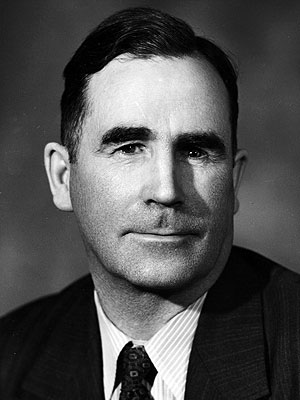
Douglas Lloyd Campbell
|
Farmer, educator, MLA (1923-1927), MLA (1927-1932), MLA (1933-1936), MLA (1937-1940), MLA (1941-1945), MLA (1946-1949), MLA (1950-1953), MLA (1954-1957), Premier of Manitoba (1948-1958), MLA (1958-1959), MLA (1959-1962), MLA (1963-1966), MLA (1966-1969).
Born at Flee Island on 27 May 1895, son of John Howard Campbell (1852-?) and Mary Campbell (1853-?), he attended Portage Collegiate. He worked as a farmer and teacher at Flee Island School before entering politics. He was also active as a Freemason, serving as Master of Assiniboine Lodge No. 7 in Portage. In 1922, Campbell defeated several other contenders to become the United Farmers of Manitoba (UFM) candidate for Lakeside. At the UFM nomination meeting, he made a virtue of his inexperience as a professional politician. A commanding speaker, he was soon regarded as a rising star in the party.
The UFM swept Manitoba’s countryside in 1922, and Campbell was elected, being returned in each of 1927 and 1932 elections. The UFM, which governed as the Progressive Party of Manitoba, was founded on an ideology of non-partisan, managerial government, with special attention to rural concerns. The Progressives formed an alliance with the Manitoba Liberal Party in 1932, and Campbell (among with the others in his party) subsequently became known as a “Liberal-Progressive.” Re-elected in July 1936, he was sworn in as Minister of Agriculture and Immigration in John Bracken’s government in December 1936. He also became Minister of the Manitoba Power Commission on 5 February 1944. In this capacity, he was responsible for overseeing a rural electrification program, which created the framework for Manitoba Hydro.
Bracken’s government created an all-party coalition in 1940, with members of the Conservative, Cooperative Commonwealth Federation (CCF), and Social Credit parties all holding cabinet positions. Campbell faced no opposition in the election of 1941, won by acclamation in 1945 and 1949, and was re-elected or acclaimed in 1949, 1953, 1958, 1959, 1962, and 1966. In 1948, when Premier Stuart Garson jumped from provincial to federal politics, Campbell defeated Conservative leader Errick Willis in a vote of the coalition caucuses to become the province’s next Premier. He was sworn in on 13 November 1948, only the second native-born Manitoban to serve in this office. He was also Minister of Dominion-Provincial Relations (1948-1958) and later added the Provincial Treasurer portfolio (1950-1951).
His government continued the rural electrification program, improved the provincial highways, and instituted a system whereby Manitoba became the first province in Canada where constituency boundaries were drawn by an independent commission. But it was otherwise cautious and conservative, opposing government expansion and bilingualism. Campbell commissioned a study on alcohol sales (written by former Premier Bracken) that brought about some reforms; nevertheless, the province maintained a number of restrictions on alcohol and Sunday shopping. Manitoba’s education system remained backwards, having the most one-room schoolhouses in Canada. The coalition government ended in 1950, with the Progressive Conservatives (as the Conservatives were then called) leaving in protest against Campbell’s “minimal-government” philosophy.
Campbell resigned as Premier on 30 June 1958. The next year, the Progressive Conservatives won a parliamentary majority under the leadership of Dufferin Roblin. Campbell resigned as Manitoba Liberal leader in 1961. He continued to serve as MLA for Lakeside until stepping down in 1969. His forty-seven continuous years in the legislature remains a provincial record. Campbell resurfaced in the 1980s as a supporter of populist conservative movements: first the Confederation of Regions Party, and subsequently the Reform Party of Preston Manning. He also spoke at rallies for Sidney Green’s Progressive Party, noting parallels to the earlier party of the same name. Campbell’s political philosophy remained consistent through his shifting party allegiances. On economic and social issues alike, he opposed most government intervention into the lives of citizens. Although not a libertarian, he was a lifelong believer in “small government.”
On 21 December 1920, he married teacher Margaret Gladys Victoria Crampton (1898-1987) at Portage la Prairie and they had seven children: Keith Crampton Campbell (1922-2011), Terence Campbell, Craig Campbell, Sharon Campbell (wife of Vic Naimish), Dawn Rue’Ann Campbell (1927-2015, wife of William John McKeag), Sonya Campbell (wife of Walter Scott Wright, mother of Campbell Greenway Wright), and Dwili Campbell (wife of Bill Burns).
He received numerous honours in recognition of his community service. He was inaugural member of the Order of the Buffalo Hunt (1957) and, during Manitoba’s centennial year celebrations in 1970, he received the Centennial Medal of Honour from the Manitoba Historical Society. In 1972, he was made an Officer of the Order of Canada, and a member of the Manitoba Agricultural Hall of Fame. He received a Queen Elizabeth II Silver Jubilee Medal (1977) and a City of Winnipeg Community Service Award (1985). He was awarded honorary doctorates by the University of Manitoba (1952), Brandon University (1967), and University of Winnipeg (1978).
He died at Winnipeg on 23 April 1995, at age 99, and was buried in the Portage Hillside Cemetery. Personal correspondence for the period 1936 to 1950 and other papers are at the Archives of Manitoba. An unpublished personal memoir is held by the Department of History at the University of Manitoba.
See also:
Historic Sites of Manitoba: Machray House (76 Harrow Street, Winnipeg)
Campbell of Manitoba by Gildas Molgat (1961).
“Douglas L. Campbell, 1948-1958 ” by James Muir in Manitoba Premiers of the 19th and 20th Centuries, edited by Barry Ferguson and Robert Wardhaugh, Canadian Plains Research Centre, 2010.
Birth and marriage registrations, Manitoba Vital Statistics.
1901 Canada census, Automated Genealogy.
“Premier takes oath of office as Treasurer,” Winnipeg Free Press, 17 February 1950, page 1.
“Douglas Campbell,” Winnipeg Tribune, 20 April 1961.
“From homestead to premier - a prairie success story,” Winnipeg Free Press, 28 October 1961.
Obituary [Margaret Gladys Campbell], Winnipeg Free Press, 2 May 1987, page 42.
Obituary, Winnipeg Free Press, 25 April 1995, page 33.
Dictionary of Manitoba Biography by John M. “Jack” Bumsted, Winnipeg: University of Manitoba Press, December 1999, 288 pages.
Keith Crampton Campbell, FindAGrave.
Obituaries and burial transcriptions, Manitoba Genealogical Society.
We thank James Kostuchuk for providing additional information used here.
This page was prepared by Gordon Goldsborough.
Page revised: 5 March 2025
Memorable Manitobans
This is a collection of noteworthy Manitobans from the past, compiled by the Manitoba Historical Society. We acknowledge that the collection contains both reputable and disreputable people. All are worth remembering as a lesson to future generations.
Search the collection by word or phrase, name, place, occupation or other text:
Custom SearchBrowse surnames beginning with:
A | B | C | D | E | F | G | H | I | J | K | L | M | N | O | P | Q | R | S | T | U | V | W | Y | ZBrowse deaths occurring in:
1975 | 1976 | 1977 | 1978 | 1979 | 1980 | 1981 | 1982 | 1983 | 1984 | 1985 | 1986 | 1987 | 1988 | 1989 | 1990 | 1991 | 1992 | 1993 | 1994 | 1995 | 1996 | 1997 | 1998 | 1999 | 2000 | 2001 | 2002 | 2003 | 2004 | 2005 | 2006 | 2007 | 2008 | 2009 | 2010 | 2011 | 2012 | 2013 | 2014 | 2015 | 2016 | 2017 | 2018 | 2019 | 2020 | 2021 | 2022 | 2023 | 2024 | 2025 | 2026
Send corrections and additions to this page
to the Memorable Manitobans Administrator at biographies@mhs.mb.caCriteria for Memorable Manitobans | Suggest a Memorable Manitoban | Firsts | Acknowledgements
Help us keep
history alive!