 |
Murdoch Mackay
|
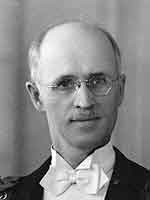
Physician, MLA (1927-1932).
Born in Boulardarie, Nova Scotia on 30 April 1884, son of John Mackay and Anna MacAulay, he attended high school there then, in August 1905, he went to Regina, Saskatchewan to attend the Regina Normal School. Following graduation, he taught school at various places in Saskatchewan until 1910. In October 1911, he enrolled in the Manitoba Medical College, graduating in November 1916.
On 14 February 1917, he married teacher Ruby May Gowland (1891-1980, daughter of James Gowland of Yorkton, Saskatchewan), two months before heading overseas as a medical officer in the Canadian Army Medical Corps. He served in England and France and experienced the loss of many young lives. He mailed a postcard showing fresh graves to his new bride, as a way of describing the desperate situation overseas.
Upon his return to Manitoba in November 1919, the couple settled into a home at 12 Victoria Avenue East in the promising new town of Transcona. In December 1919, he purchased the medical practice of D. V. S. Winkler. He continued until illness forced his retirement in December 1953. The couple raised four daughters: Ruby Mackay (1922-1995, wife of James Mason), Murdina Joanne Mackay (1924-2017, wife of William Richard Brownlee), Elizabeth Jean Mackay (1926-2015, wife of Robert Nixon and Howard Curtis), and Donalda Heather “Donna” Mackay (1929-2004, wife of J. Manser).
In 1927, he was elected to the Manitoba Legislature as a member of the Liberal Party. He became leader of the party in June 1931 when his predecessor Hugh Amos Robson was given a judgeship. Mackay served for one year before being defeated in the 1932 general election. He was not a candidate in the 1936 and 1941 elections, but was defeated in a bid for election in 1945.
He was an active member of the Transcona Memorial United Church, Canadian Legion, Knights of Pythias, AF & AM (Transcona Lodge), Shriners, Transcona Curling Club, Elmhurst Golf and Country Club, Canadian Club of Winnipeg, and Transcona Board of Trade (President).
He died at the St. Boniface Hospital on 18 December 1962 and was buried in the Transcona Cemetery. He is commemorated by Murdoch Mackay Collegiate in Winnipeg.
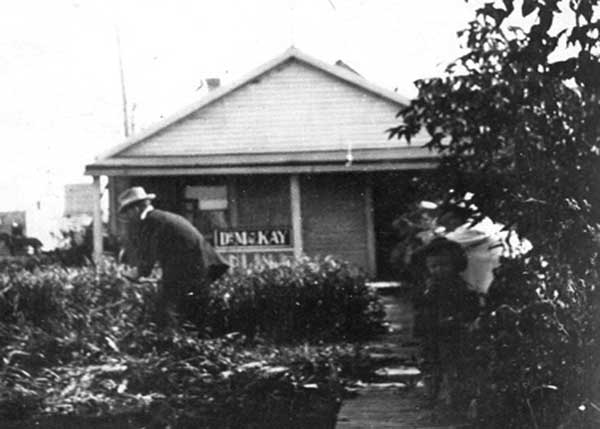
The Mackay home and garden (no date)
Source: Transcona Historical Museum
See also:
Historic Sites of Manitoba: Murdoch Mackay Collegiate (260 Redonda Street, Winnipeg)
Historic Sites of Manitoba: Transcona Wall of Fame (Regent Avenue West, Winnipeg)
1921 Canada census, Library and Archives Canada.
The Canadian Parliamentary Guide, 1929.
“D. M. MacKay, former Liberal chief, dies at 78,” Winnipeg Tribune, 20 December 1962, page 19.
Obituary, Winnipeg Free Press, 29 December 1962, page 25.
Dictionary of Manitoba Biography by John M. “Jack” Bumsted, Winnipeg: University of Manitoba Press, December 1999, 288 pages.
Obituary [Donalda Heathe Manser], Winnipeg Free Press, 7 February 2004.
River East Transcona School Division newsletter, The Torch, Spring 2005, submitted by Cheryl Moore.
Obituary [Elizabeth Jean Curtis], Winnipeg Free Press, 19 September 2015.
Obituary [Murdina Joanne Brownlee], Winnipeg Free Press, 20 May 2017.
Obituaries and burial transcriptions, Manitoba Genealogical Society.
We thank Oliver Bernuetz (Legislative Library of Manitoba) and Tara Nixon for providing additional information used here.
This page was prepared by Gordon Goldsborough.
Page revised: 24 December 2023
Memorable Manitobans
This is a collection of noteworthy Manitobans from the past, compiled by the Manitoba Historical Society. We acknowledge that the collection contains both reputable and disreputable people. All are worth remembering as a lesson to future generations.
Search the collection by word or phrase, name, place, occupation or other text:
Custom SearchBrowse surnames beginning with:
A | B | C | D | E | F | G | H | I | J | K | L | M | N | O | P | Q | R | S | T | U | V | W | Y | ZBrowse deaths occurring in:
1975 | 1976 | 1977 | 1978 | 1979 | 1980 | 1981 | 1982 | 1983 | 1984 | 1985 | 1986 | 1987 | 1988 | 1989 | 1990 | 1991 | 1992 | 1993 | 1994 | 1995 | 1996 | 1997 | 1998 | 1999 | 2000 | 2001 | 2002 | 2003 | 2004 | 2005 | 2006 | 2007 | 2008 | 2009 | 2010 | 2011 | 2012 | 2013 | 2014 | 2015 | 2016 | 2017 | 2018 | 2019 | 2020 | 2021 | 2022 | 2023 | 2024 | 2025 | 2026
Send corrections and additions to this page
to the Memorable Manitobans Administrator at biographies@mhs.mb.caCriteria for Memorable Manitobans | Suggest a Memorable Manitoban | Firsts | Acknowledgements
Help us keep
history alive!