 |
Frank Oliver Fowler
|
Grain dealer, MLA (1897-1899), MLA (1899-1903), Mayor of Winnipeg (1922).
 |
Frank Oliver Fowler
|
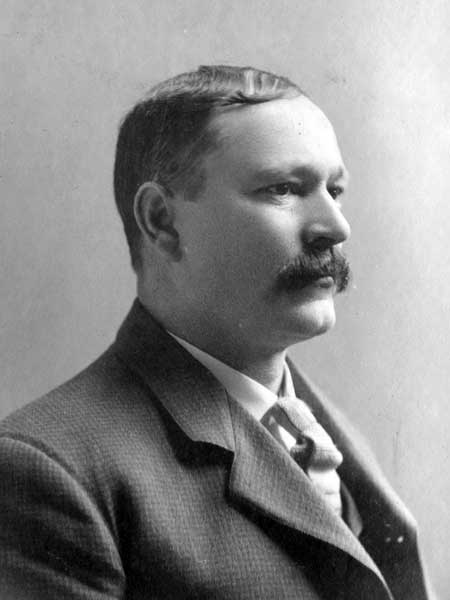
Born at Wingham, Ontario on 14 December 1861, son of William Oliver Fowler and Helen Oliver (?-?), brother of Alexander Fowler, after his education in the public and high schools, he worked in a saw mill until, at the age of 20, he came west and farmed near Brandon for 11 years. In 1891 he started a grain business at Wawanesa.
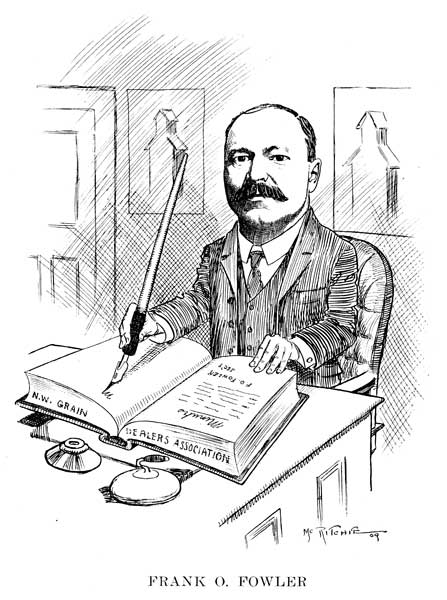
He served as Reeve of the Rural Municipality of Oakland (1892-1894) and was the Returning Officer in the South Brandon constituency in the 1896 provincial general election. He was elected in an 1897 provincial by-election and the 1899 general election. He moved to Winnipeg in 1902, where he was appointed Secretary-Treasurer of the North West Grain Dealers’ Association and Manager of the Winnipeg Grain and Produce Clearing Association.
He was active in municipal politics, first as a Winnipeg City Alderman starting in 1908. In 1918 he introduced a motion denying all civic employees the right to strike, which narrowly passed Council by a vote of nine to eight. On 26 May 1919 he co-introduced a motion prohibiting firemen from belonging to any union affiliated with an organization that could give it commands contradictory to Council’s orders. It passed by a vote of nine to five. He was later Mayor of Winnipeg, elected by acclamation in 1922. During his term in office, the city’s hydroelectric system was developed and the Greater Winnipeg Water District was organized.
He and wife Elizabeth Nichol Henderson (1867-1923) had five children: Frank Scott Fowler, Helen Audrey Fowler (1889-1983, wife of John Stewart Macarthur), Harold Arthur Fowler (1891-1948), Raymond Fowler (1894-1930), and Frances Isabel Fowler (1904-?, wife of J. J. Carter). A close associate of Clifford Sifton and John Wesley Dafoe, he was a founding member, in 1905, of the St. Charles Country Club. He served as President of the Manitoba Curling Association (1904-1905) and was made an Honorary Life Member (1922).
He died at Winnipeg on 18 February 1945 and was buried in the Elmwood Cemetery. He is commemorated by Fowler Street in Winnipeg.
1901 Canada census, Automated Genealogy.
Birth registrations, Manitoba Vital Statistics.
“Old-timer dies,” Winnipeg Tribune, 15 March 1906, page 10.
A History of Manitoba: Its Resources and People by Prof. George Bryce, Toronto: The Canadian History Company, 1906.
“Funeral of Mrs. Fowler will be held today,” Manitoba Free Press, 13 February 1923, page 13.
“Ex-Mayor of Winnipeg dies,” Winnipeg Free Press, 19 February 1945, page 1.
Ramsay Cook (editor), The Dafoe-Sifton Correspondence, 1919-1927. The Manitoba Record Society, 1966.
Obituary [Helen Audrey Macarthur], Winnipeg Free Press, 20 July 1983, page 44.
Dictionary of Manitoba Biography by John M. “Jack” Bumsted, Winnipeg: University of Manitoba Press, December 1999, 288 pages.
This page is based, in part, on information compiled by historian Harry Shave.
We thank Terry Webber and Rick Wilson for providing additional information used here.
This page was prepared by Gordon Goldsborough.
Page revised: 30 June 2025
Memorable Manitobans
This is a collection of noteworthy Manitobans from the past, compiled by the Manitoba Historical Society. We acknowledge that the collection contains both reputable and disreputable people. All are worth remembering as a lesson to future generations.
Search the collection by word or phrase, name, place, occupation or other text:
Custom SearchBrowse surnames beginning with:
A | B | C | D | E | F | G | H | I | J | K | L | M | N | O | P | Q | R | S | T | U | V | W | Y | ZBrowse deaths occurring in:
1975 | 1976 | 1977 | 1978 | 1979 | 1980 | 1981 | 1982 | 1983 | 1984 | 1985 | 1986 | 1987 | 1988 | 1989 | 1990 | 1991 | 1992 | 1993 | 1994 | 1995 | 1996 | 1997 | 1998 | 1999 | 2000 | 2001 | 2002 | 2003 | 2004 | 2005 | 2006 | 2007 | 2008 | 2009 | 2010 | 2011 | 2012 | 2013 | 2014 | 2015 | 2016 | 2017 | 2018 | 2019 | 2020 | 2021 | 2022 | 2023 | 2024 | 2025 | 2026
Send corrections and additions to this page
to the Memorable Manitobans Administrator at biographies@mhs.mb.caCriteria for Memorable Manitobans | Suggest a Memorable Manitoban | Firsts | Acknowledgements
Help us keep
history alive!