
Date: 21 August 1871 and 23-24 August 1875
Location: Manitoba Post (House), Kinosota
Treaty Two was initially negotiated on 21 August 1871 at Manitoba Post (Kinosota), Manitoba. [1] The popular understanding is that Treaty Two involved the surrender of approximately 25 million acres from the Anishinaabe to the Dominion of Canada in exchange for financial and material compensation. [2] Similarly, the inspiration for Treaty Two for Canada has been understood to be obligations related to the Rupert’s Land Transfer Order and/or the Royal Proclamation of 1763 (the Proclamation). [3] The archival record—although thin in comparison to the other southern Numbered Treaties (Treaties One to Seven)—tells a different story. [4] Rather than a summary surrender of land, Treaty Two created a relationship between the Crown and the Anishinaabe that continues today. [5]
Canadian expansionists had started to arrive in what is now Western Canada as early as 1859. [6] Two years earlier Henry Youle Hind led a Canadian expedition to investigate the region of the North-West (which spans as far west as the Rocky Mountains and as east as Lake Superior). The Hind (and British-led Palliser) Expeditions identified 44,000 square kilometres of fertile land in the North-West that prompted Canada to make provision for the entry of the region into Confederation in 1867. [7] In 1869, negotiators for Canada and the Hudson’s Bay Company (HBC) had brokered a deal to transfer the North-West from the HBC to Canada for the sum of £300,000. [8] Almost immediately, Canadians began to move into the region as Canada assumed authority over the North-West. [9] It was this assumption of authority that encouraged acts of resistance from Indigenous Peoples. The Red River Resistance of 1869-70, for example, was not so much a resistance to the presence of Canadians as it was a resistance to their presence without recognition of Métis land rights. [10]
The typical way that Canadian (and previously British) authorities dealt with Indigenous land rights was through treaty. Many historians have argued that the southern Numbered Treaties were modelled on the Robinson (1850) and Manitoulin Island (1862) Treaties. [11] The legal obligations of Canada in both circumstances were similar. While term 14 of the Rupert’s Land Order affirmed similar obligations towards the Indigenous Peoples of the North-West, the Proclamation has been assumed to apply as much to the southern Numbered Treaties as to the Robinson and Manitoulin Island Treaties. [12] Term 14 of the Rupert’s Land Order established Canada’s responsibility to dispose of “claims of Indians to compensation for lands” in communication with the Imperial government. [13] The Proclamation required that Indian title be extinguished prior to the beginning of settlement or land surveys. [14] Canada’s failure to deal with Indian title prior to settlement and survey prompted acts of resistance across the North-West.
In 1868, Oozawekean’s (Yellow Quill) Saulteaux/Anishinaabe band forcibly prevented Canadians from travelling further west than Portage la Prairie. [15] Two years later, with a treaty still not in place, Moosoos of the Portage Band posted a notice in High Bluff warning Canadians that the lands they were trespassing on “still belong to the Indians.” [16] More aggressive acts of resistance came from the First Nations in what is now Treaty Six territory when they obstructed telegraph line and geological surveys in the absence of a treaty. [17] Further west, Blackfoot chiefs in Treaty Seven territory wrote to Lieutenant-Governor Alexander Morris that “the white men have already taken the best location and built houses in any place they pleased in our ‘hunting grounds’” even though Morris’ predecessor, Adams G. Archibald, had promised them in 1871 that lands would not be taken without their consent. [18] The same year that Archibald made this promise to the Blackfoot chiefs, he was pre-occupied with the negotiations of Treaties One and Two—the latter of which was negotiated only after the First Nations of the Riding Mountain region forbid the entry of Canadians without a treaty. [19]
That Canada took the threats of First Nations seriously weakens the argument advanced by some historians that Canada’s authority in the North-West was never in doubt. [20] On the contrary, prior to treaty-making, Canada’s presence in the region was in jeopardy. In 1870, the population of Manitoba was recorded as 12,228, 11,208 of whom were born in the North-West—indicative of the prevailing dominance of Indigenous Peoples (either First Nations, Métis, or Anglo-Metis) in the province. [21] Elsewhere in the North-West, the estimated First Nations population was placed at 14,500 by The Manitoban in July 1871. [22] Anglo-Metis HBC trader Richard Hardisty—who was briefly the Chief Trader at Manitoba Post where Treaty Two was negotiated—feared “an Indian war that none of us may live to see the end of” if Canadians poured into Saskatchewan. [23] Similarly, in 1872 Colonel Patrick Robertson-Ross—who surveyed the North-West in his capacity as Adjutant General of the Militia—observed that “the white men dwelling in the Saskatchewan are at this moment living by sufferance, as it were, entirely at the mercy of the Indians.” [24] Evidently, the southern Numbered Treaties, including Treaty Two, were negotiated for the purpose of securing Canada’s presence in the region instead of merely achieving an extinguishment of Indian title.
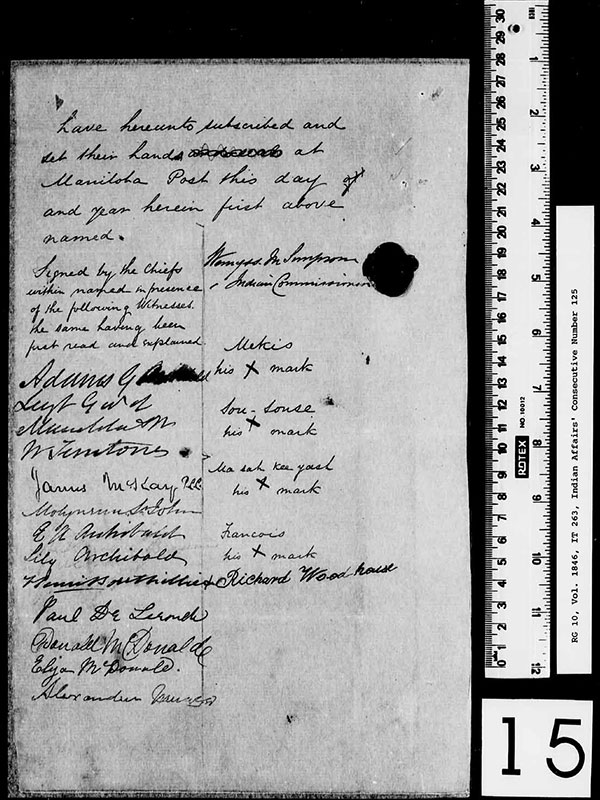
Following the negotiations of Treaty One, Archibald, Indian Commissioner Wemyss M. Simpson, and Crown negotiators James McKay and Molyneaux St. John travelled to Manitoba Post to meet with Chiefs Sou-Sonse (Swan Creek and Lake Manitoba), Ma-sah-kee-yash and Woodhouse (Fairford), François (Waterhen River and Crane River), and Mekis (Riding Mountain and Dauphin River). Delayed by adverse weather, the Crown negotiators arrived on 19 August 1871 by which time the Anishinaabe negotiators had learned of the terms of Treaty One. Following two days of negotiations these terms were agreed to by the Anishinaabe negotiators. [25] The bands that are party to Treaty Two are:
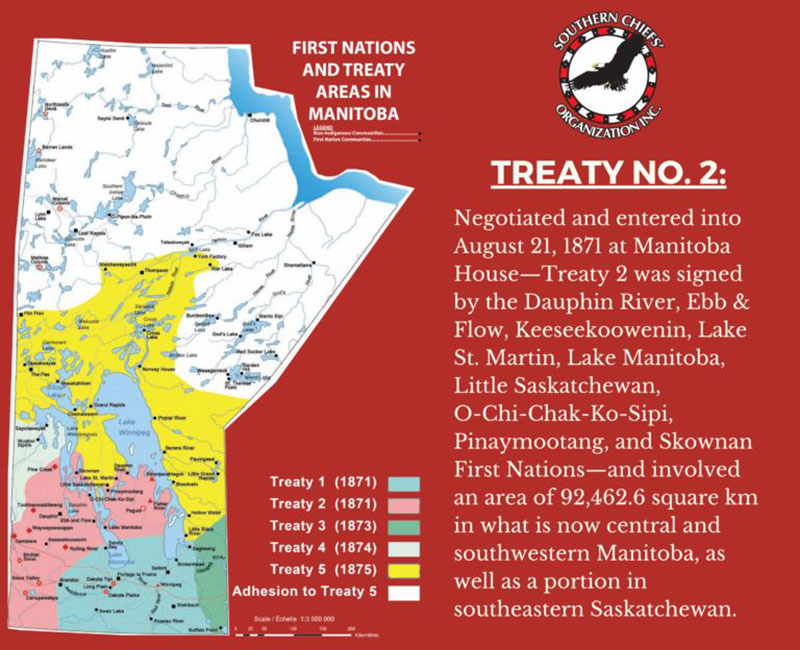
Dauphin River First Nation
Skownan First Nation
Ebb and Flow First Nation
Keeseekoowenin First Nation
Lake Manitoba First Nation
Lake St. Martin First Nation
Little Saskatchewan First Nation
O-Chi-Chak-Ko-Sipi First Nation
Pinaymootang First Nation [26]
The written terms of Treaty Two involved the ‘surrender’ of around 25 million acres in exchange for reserves of land consisting of 160 acres per family of five. The Anishinaabe also secured promises of educational assistance and annuities. [27] The success of the Crown negotiators was recorded by The Manitoban on 2 September in an article that read: “[b]y this treaty upwards of twenty-eight million acres of waste land in the North-West are opened up for settlement.” [28]
The description of the territory of Treaty Two as waste land belies the value that Crown negotiators and Canadians placed on the territory. When The Manitoban reported on the resistance of Riding Mountain First Nations, the territory was described as “the finest region in the country.” [29] Both Archibald and Simpson understood the resource wealth of the lands. [30] The latter acknowledged “certain wood and water privileges” of the territory. [31] After Treaty Two was concluded, Simpson reported that the lands of Treaty One were “fully equalled if not exceeded by the country of which the Government now comes into possession, by virtue of the treaty concluded at Manitoba Post.” [32]
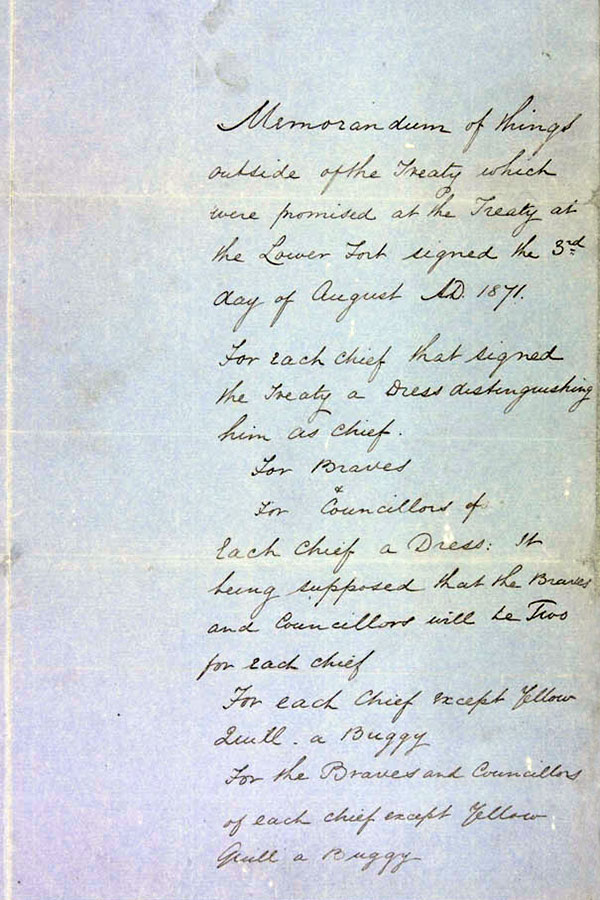
That the First Nations understood the value of these lands is beyond doubt. By 5 November 1873, Morris was informed that Treaty Two was not seen as binding “by the great body of Indians” of the North-West. [33] As he set about to negotiate Treaty Four in 1874, Morris’ efforts were disrupted by the Portage band (signatories of Treaty One) who sent emissaries “to Qu’Appelle to prevent a treaty from being made there.” [34] The source of discontent for the First Nations of Treaties One and Two was Canada’s failure to uphold a series of ‘Outside Promises’ that comprised the terms of these treaties. Since the failure of Canada to uphold these promises proved harmful to Canada’s security in the North-West, Morris and Indian Commissioner J.A.N. Provencher were instructed to visit the signatories of Treaties One and Two to obtain their consent to the inclusion of the Outside Promises in the treaty. [35] Morris instructed Provencher to meet with several Treaty One First Nations while he and McKay travelled to Manitoba Post to meet with the First Nations of Treaty Two. [36]
While at Manitoba Post, Morris recorded a memo describing the grievances of the Treaty Two First Nations. [37] The memo corresponded to the contents of the Outside Promises which provided for “a bull for each [reserve], and a cow for each Chief; a boar for each reserve, and a sow for each Chief, and a male and female of each of kind of animal raised by farmers; these when the Indians are prepared to receive them. A plow and a harrow for each settler cultivating the ground.” [38] After Morris had secured the consent of the Treaty Two First Nations on 24 August 1875, he wrote to the Minister of the Interior, David Laird, “that a better system of Indian administration should be devised so as to secure the prompt and rigid carrying out of the new terms in their entirety.” [39] On 8 July 1875, Laird had assented to the “necessity of placing the management of the Treaties 1, 2 + 3 on a better footing than at present existed.” [40]
The failure of Canada to uphold treaty obligations, both before and after the renegotiation of Treaty Two, has prompted some historians to argue that the southern Numbered Treaties were understood differently by the negotiating parties. [41] The circumstances under which these treaties were negotiated challenges this view generally while the direct involvement of the three principal Crown negotiators (Simpson, Morris, and Laird) in Treaty Two makes such an argument especially weak with respect to Treaty Two. The idea of misunderstanding is premised on the idea that Canada enjoyed a secure position in the North-West. [42] The demographics of the region undermine this idea but even more fatal is the position of Canada relative to the United States. While the United States was spending $20 million on Indian Wars in the 1870s, Canada’s entire budget was $19 million. [43] Therefore, Canada was in no position to overpower First Nations militarily once the latter resisted the former’s authority. Indeed, John A. Macdonald had admitted that if it were not for the threat of the Americans he would have been “quite willing, personally, to leave that whole Country a wilderness for the next half century.” [44] With Canada under the threat of American invasion and First Nations facing the decimation of the bison, among other challenges, the circumstances of the southern Numbered Treaties resemble those of Canadian Confederation in the previous decade more than they do those of the Robinson and Manitoulin Island Treaties.
That the nature of the treaty relationship would be any less significant than the relationship between the Canadian provinces is not supported by the views of Treaty Two by Simpson, Morris, and Laird—who were each a principal negotiator of at least one of the southern Numbered Treaties and were all directly involved in the negotiation of Treaty Two. Arthur J. Ray, Jim Miller, and Frank J. Tough observed that Simpson accepted the understanding of Treaty One communicated to the signatories of Treaty Two by other First Nations—which entailed sharing, reciprocity, and respect rather than a real estate transaction. [45] Morris also demonstrated an understanding of the treaty relationship in this manner and his sidelining within the Department of the Interior was due to his insistence on a faithful fulfilment of the treaty relationship. [46] Laird—who replaced Morris as the principal negotiator for Treaty Seven in 1877—shared his predecessor’s understanding of the treaty relationship during the renegotiation of Treaties One and Two. [47] Clearly Treaty Two was neither a land surrender nor the product of misunderstanding but the establishment of a relationship between the Anishinaabe and the Crown.
Commemorations of Treaty Two are limited (especially in comparison to the other southern Numbered Treaties). The Directory of Federal Heritage Designations contains no entry for Treaty Two while they exist for Treaties One, Three, and Six, National Historic Site designations for Fort Qu’Appelle (Treaty Four) and Carlton House (Treaty 6). [48] Elsewhere, Treaty One has been commemorated with a plaque at Lower Fort Garry (where Treaty 1 was signed) but no such plaque exists for Treaty Two at Manitoba Post. [49] When Treaty Two has been commemorated—as in the Canadian Encyclopedia’s entry for “Treaties 1 and 2”—it has been treated as little more than adhesion to Treaty One. “Treaties 1 and 2” also continues the treatment of the southern Numbered Treaties as consisting of two perspectives on the meaning of the treaty and argued that a misunderstanding was possible. [50] As the evidence presented demonstrates, the circumstances of Treaty Two’s negotiation do not support this version of the event. The Assembly of Manitoba Chiefs’ commemoration of Treaty Two’s 150th anniversary is a step toward a more accurate portrayal of this event. It is time that a commemoration of Treaty Two reflects both its historical significance and the true spirit and intent of the treaty relationship.
See also:
Directory of Federal Heritage Designations, Government of Canada
Treaty (No. 2) made at Manitoba Post - Western Treaty No. 2, Library and Archives Canada.
Treaty Texts – Treaties No. 1 and No. 2, Government of Canada.
Canada Sessional Papers. Report of the Indian Branch of the Department of the Secretary of State for the Provinces, no. 22, 3-34. Ottawa: I.B. Taylor, 1872.
Wayne E. Daugherty, “Treaty Research Report: Treaty One and Treaty Two (1871),” 1983. Gretchen Albers, “Treaties 1 and 2,” Canadian Encyclopedia.
Laird, David. “North-West Indian Treaties,” Manitoba Historical Society 1, no. 67 (1905).
Historic Sites of Manitoba: Riding Mountain National Park Monument (Wasagaming, Riding Mountain National Park)
Manitoba Communities: Brandon (City)
Manitoba Communities: Dauphin (City)
Signatory Page, Treaty (No. 2) made at Manitoba Post - Western Treaty No. 2, Library and Archives Canada
Memorandum of things outside of the Treaty which were promised at the Treaty at the Lower Fort, signed the 3rd day of August, A.D. 1871,” Wemyss M. Simpson to Alexander Morris, 2 August 1876, Library and Archives Canada.
Map of Treaty territories, Southern Chiefs’ Organization
Jack Joseph Nestor is a Canadian graduate student in the Joint Master’s Program (History) at the Universities of Manitoba and Winnipeg. His thesis research concerns the application of the Royal Proclamation of 1763 in the context of the southern Numbered Treaties. He is from Rouleau, Saskatchewan.
This article was produced as part of a collaborative public history project between students in the Department of History and Joint Masters History Program at the University of Winnipeg, the Southern Chiefs’ Organization, and the Manitoba Historical Society. Honours and Masters students researched and wrote digital public history articles that align with the Southern Chiefs’ Organization 25th Anniversary History Project and contribute to the expansion of Indigenous history content on the Manitoba Historical Society website. Course: Commemorating Indigenous Histories, HIST-4614/GHIST-7513, Winter 2025, Instructor: Dr. Erin Millions.
1. “The Indian Treaty,” The Manitoban, 2 September 1871, Provincial Archives of Saskatchewan (PAS), R-1.998/1.
2. J. R. Miller, Compact, Contract, Covenant: Aboriginal Treaty-Making in Canada (Toronto: University of Toronto Press, 2009) 164-165.
3. Arthur J. Ray, Jim Miller, and Frank J. Tough, Bounty and Benevolence: A History of Saskatchewan Treaties (Montreal & Kingston: McGill-Queen’s University Press, 2000) 68.
4. Sheldon Krasowski, No Surrender: The Land Remains Indigenous (Regina: University of Regina Press, 2019), 10 and 73.
5. James Cote, Elmer Courchene and William G. Lathlin with contributions by the Council of Elders, Gakina Gidagwi’igoomin Anishinaabewiyang—We Are All Treaty People: Treaty Elders’ Teachings Volume 4 (Winnipeg: Treaty Relations Commission of Manitoba, 2016) 58.
6. “The First Newspaper at Red River: Prospectus: The Nor-Wester,” The Nor’Wester, 22 August 1859, PAS, R-1.648/1; J.M.S. Careless, Brown of the Globe: Volume II: Statesman of Confederation, 1860-1880 (Toronto: The Macmillan Company of Canada Limited, 1963) 7.
7. Kent McNeil, Native Claims in Rupert’s Land and the North-Western Territory: Canada’s Constitutional Obligations (Saskatoon: University of Saskatchewan, Native Law Centre, 1982) 9; John Herd Thompson, Forging the Prairie West (Don Mills: Oxford University Press, 1998) 34.
8. Ray, Miller, and Tough, Bounty and Benevolence, 50.
9. Carl Berger, The Sense of Power: Studies in the Ideas of Canadian Imperialism, 1867-1914 (Toronto: University of Toronto Press, 1970) 56.
10. Miller, Compact, Contract, Covenant, 142.
11. Ray, Miller, and Tough, Bounty and Benevolence, 61; D.J. Hall, From Treaties to Reserves: The Federal Government and Native Peoples in Territorial Alberta, 1870-1905 (Montreal & Kingston: McGill-Queen’s University Press, 2015) 44.
12. Krasowski, No Surrender, 20.
13. McNeil, Native Claims, 11.
14. Kenneth M. Narvey, “The Royal Proclamation of 7 October 1763, The Common Law and Native Rights to Land within the Territory Granted to the Hudson’s Bay Company,” Saskatchewan Law Review 38 (1974): 232.
15. John L. Tobias, “Canada’s Subjugation of the Plains Cree, 1879-1885,” in Sweet Promises: A Reader on Indian-White Relations in Canada, ed. J.R. Miller (Toronto: University of Toronto Press, 1991) 213.
16. Aimée Craft, Breathing Life Into the Stone Fort Treaty: An Anishinabe Understanding of Treaty One (Saskatoon: Purich Publishing Limited, 2013) 43.
17. Ray, Miller, and Tough, Bounty and Benevolence, 100-104.
18. Provincial Archives of Manitoba, P5284/8, Alexander Morris Fonds, Petition of the Chokitapix or Blackfeet Indian Chiefs to Lieut.-Gov. Morris, 1265.
19. Craft, Stone Fort Treaty, 43.
20. Hall, From Treaties to Reserves, 22.
21. Department of Agriculture, Census of Canada, 1870-71 (Ottawa: I.B. Taylor, 1876) 386-387.
22. “The Treaty,” The Manitoban, 29 July 1871.
23. Ray, Miller, and Tough, Bounty and Benevolence, 98-99; “Historic Sites of Manitoba: Manitoba House (Kinosota, RM of Alonsa), Manitoba Historical Society, last updated 6 August 2022.
24. Quoted in Noel Evan Dyck, “The Administration of Federal Indian Aid in the North-West Territories, 1879-1885,” M.A. thesis (University of Saskatchewan, 1970) 9.
25. Krasowski, No Surrender, 74.
26. “ANT2T Local Nations,” Government of Anishinaabe Nation in Treaty 2 Territory.
27. “The Indian Treaty,” The Manitoban, 2 September 1871.
28. “The Indian Treaty,” The Manitoban, 2 September 1871.
29. Craft, Stone Fort Treaty, 43.
30. Krasowski, No Surrender, 74.
31. In Alexander Morris, Treaties of Canada the Indians of Manitoba and the North-West Territories, Including the Negotiations on Which They Were Based, and Other Information Relating Thereto (Calgary: Fifth House Publishers, 1991) 42.
32. Morris, Treaties of Canada, 42.
33. PAM, P5279/10, Alexander Morris Fonds, E.A. Meredith to Morris, 5 November 1873, 548.
34. Ray, Miller, and Tough, Bounty and Benevolence, 83.
35. Morris, Treaties of Canada, 127.
36. Morris, 128.
37. PAM, P5283/3, Alexander Morris Fonds, Memo, 23 August 1875, 1089.
38. PAM, P5285/1, Alexander Morris Fonds, Wemyss M. Simpson to Alexander Morris, 2 August 1876, 1299.
39. Morris, Treaties of Canada, 134.
40. PAM, P5283/1, Alexander Morris Fonds, Laird to Morris, 8 July 1875, 1034.
41. See Krasowski, No Surrender, 30.
42. George F.G. Stanley, The Birth of Western Canada: A History of the Riel Rebellions (Toronto: University of Toronto Press, 1963) 209; Hall, From Treaties to Reserves, 21 and 60.
43. Michael Asch, On Being Here to Stay: Treaties and Aboriginal Rights in Canada (Toronto: University of Toronto Press, 2014) 155.
44. J. R. Miller, “Macdonald as Minister of Indian Affairs: The Shaping of Canadian Indian Policy,” in Macdonald at 200: New Reflections and Legacies, eds. Patrice Dutil and Roger Hall (Toronto: Dundurn Press, 2014) 319.
45. Ray, Miller, and Tough, Bounty and Benevolence, 59 and 68.
46. Robert J. Talbot, Negotiating the Numbered Treaties: An Intellectual & Political Biography of Alexander Morris (Saskatoon: Purich Publishing Limited, 2009) 154-160.
47. Brian Titley, The Indian Commissioners: Agents of the State and Indian Policy in Canada’s Prairie West, 1873-1932 (Edmonton: University of Alberta Press, 2009) 50.
48. Parks Canada, “Indian Treaty No. 1 National Historic Event (NHE),” Parks Canada, “Indian Treaty No. 3 National Historic Event (NHE),” Parks Canada, “Indian Treaty No. 6 National Historic Event (NHE),” Parks Canada, “Fort Qu’Appelle National Historic Site of Canada (NHS),” Parks Canada, “Carlton House National Historic Site of Canada (NHS).”
49. “Historic Sites of Manitoba: Treaty No. 1 Plaque (Lower Fort Garry, RM of St. Andrews),” Manitoba Historical Society.
50. Gretchen Albers, “Treaties 1 and 2,” The Canadian Encyclopedia, last updated 5 August 2021.
Page revised: 26 February 2026