The Manitoba Historical Society tracks historically-significant buildings around our province that deserve to be preserved and better known. On 23 June 2026, we announced our list of ten endangered buildings and other structures, in order from oldest to newest.
1853
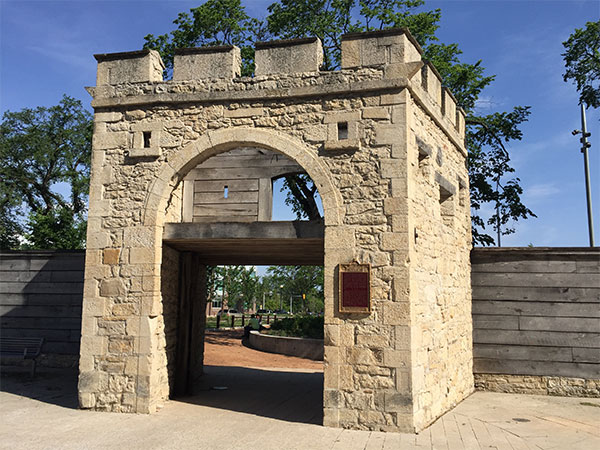
Upper Fort Garry Gate
130 Main Street, WinnipegOne of Winnipeg’s enduring landmarks, the Upper Fort Garry, or Governor’s Gate, was built around 1853 as part of a northern extension to the 1835 Hudson’s Bay Company fort: seminal to the company’s commercial network, associated with First Nations, Metis peoples and the fur trade, and, for decades, the administrative, political and social hub of the Red River Settlement. Here Louis Riel’s provisional government was established and operated during the 1869-1870 Red River Resistance; Thomas Scott was executed in 1870; and, that year, the Council of Assiniboia voted for Manitoba´s inclusion in Canada.
The only above-ground remnant of the fort, the Upper Fort Garry Gate was the subject of Winnipeg’s first heritage preservation campaign, spearheaded by the Manitoba Historical Society between 1888 and 1897. That year, the gate and four surrounding lots were gifted by the Hudson’s Bay Company to the City of Winnipeg “as a public park forever.” Over time, the fort was recognized as a national historic site (1926), the gate was restored and partly rebuilt, through the Agreement for Recreation and Conservation (ARC) program (1982-1983) and, more recently, provided with larger grounds and provincial park status (2010). Through the efforts of the Friends of Upper Fort Garry (starting in around 2007 to develop the larger park) there is not only this public space but imaginative physical and interactive interpretation of it.
Our concern is that the gate needs ongoing vigilance and maybe repair. People are entering the second-floor gallery with evidence of fire damage and strewn garbage. In the past month, we have been advised of a fire close to the gate in the park. There is longstanding graffiti on the wood gallery and incidents of tagging the limestone walls. And while we are not engineers or architects, there are large cracks in the stonework, aesthetically, at least, calling for expert consideration. Although ground lights are installed at the base of the structure, we have seen it dark at night, hardly highlighting this landmark or contributing to safety.
1904
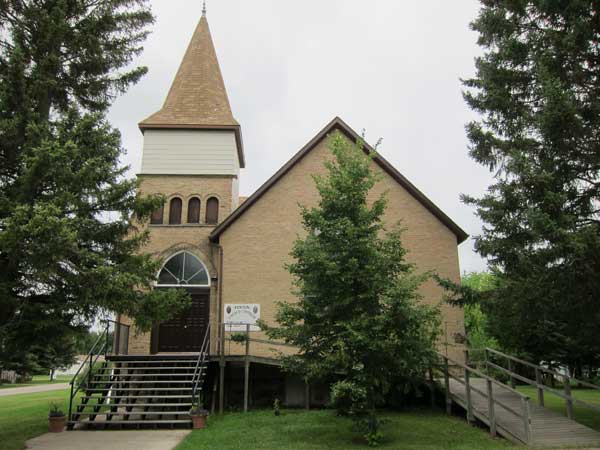
Kenton Presbyterian Church
Kenton, RM of Wallace-WoodworthThe United Church of Canada has had a profound impact on Manitoba through its blend of social activism, community service, and rural ministry. Rooted in the Social Gospel tradition, a movement energized by events such as the 1919 Winnipeg General Strike, the church became an advocate for unemployment insurance, old‑age pensions, universal health care, and other reforms aimed at improving daily life.
Its presence was especially strong in rural Manitoba. When Methodist, Presbyterian, and Congregationalist congregations united in 1925, the new denomination instantly became the province’s largest Protestant body in terms of buildings. A provincial architectural survey in the 1980s documented over 450 relevant church buildings across the predecessor traditions.
Today, the United Church faces a marked decline in Manitoba. Demographic change, shrinking congregations, and a severe shortage of ministers leave many communities without stable leadership. Once‑central rural churches now struggle to sustain programs, maintain buildings, and attract new members, affecting not only congregations but the wider community life they long supported.
Kenton is a clear example. Its brick Presbyterian church, built in 1904 and becoming a United Church in 1925, has been an anchor in a multi‑point charge with Hamiota, Oakner, and Shiloh. Yet it now faces the same pressures as other rural congregations. Aside from a well‑attended Christmas service in 2023 and one early in 2024, it has been largely vacant. As the only church remaining in town, it might find new life as a community church serving a broader spectrum of residents or, like other rural churches, through a creative adaptive reuse that preserves this architectural landmark.
1923

Manitoba Air Photo Library
14 Fultz Boulevard, WinnipegManitoba’s first comprehensive aerial photos were taken in 1923, when First World War pilots were hired by the federal government to begin aerial surveying from a base at Victoria Beach. Few Manitobans had ever seen an aerial view, but these images were far more than curiosities; they allowed cartographers to map regions that had never been mapped before. Two cartographers even devised a method to convert angled, oblique photos into usable maps.
When Manitoba gained control of its natural resources in 1930, one of its first steps was to create a Surveys Branch. Boundary surveys began immediately, and aerial photography became essential to the work. After the Second World War, another generation of pilots returned home, and in 1948-49 thousands more photographs were taken. Much of the focus was northern Manitoba — mapping for mining and forestry — but the images also supported agricultural planning, and the routing of hydro lines, telephone lines, and highways.
The province formally established the Manitoba Air Photo Library in 1948 to preserve this rapidly growing archive, which already held about 65,000 images. Those late‑1940s photographs remain invaluable today because they capture information about a landscape that has been massively transformed in the past seven decades. The library is now believed to contain over one million unique views of Manitoba.
In 2025, the province announced the closure of its dedicated map‑sales office, which also housed the Air Photo Library. The government has promised updates on digitization and long‑term preservation, but key questions remain: Will the original photographs be saved, or only digital scans? Will public access be assured? The uncertain fate of this irreplaceable historical resource is why it appears on this list.
1927
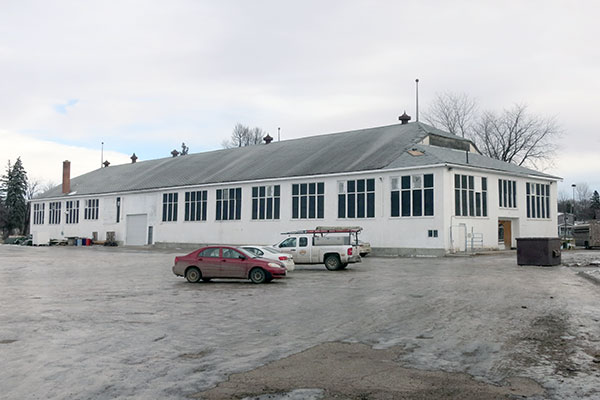
Manitoba Government Display Building
Fairgrounds, BrandonBrandon’s fairs date back to 1882, only months after the city was founded. The Summer Fair’s early purpose was straightforward: promote livestock sales (especially horses) and encourage better breeding and animal care. Over time, lectures, government exhibits, and equipment dealers broadened the fair into a full family event. In 1913, when Brandon hosted the Dominion Fair, the federal government built a major exhibition hall to showcase national programs. Neglected for decades, it was listed as an endangered structure in 2009, prompting a restoration completed in 2018. It now serves as an event venue and home to the Provincial Exhibition offices.
Beside it stands a far less noticed but just as historically significant building, now 99 years old. Its story began in 1926, when the Summer Fair and the Manitoba government sought a dedicated space to present provincial programs and services. Construction began late that year, and the building opened for the 1927 Fair.
In 1952, its interior walls were removed to create a large open hall, transforming it into the Manitoba Trade Fair Building — the first of its kind in the province. The trade fair remains part of today’s Summer Fair, though no longer held inside this structure.
Now closed and used mainly for cold storage, the building suffers from a leaking roof and broken windows. Yet its east entrance still bears eight aspirational words from 1927: Education, Agriculture, Industry, Commerce, Co‑operation, Conservation, Progress, and Thrift.
1923-1927
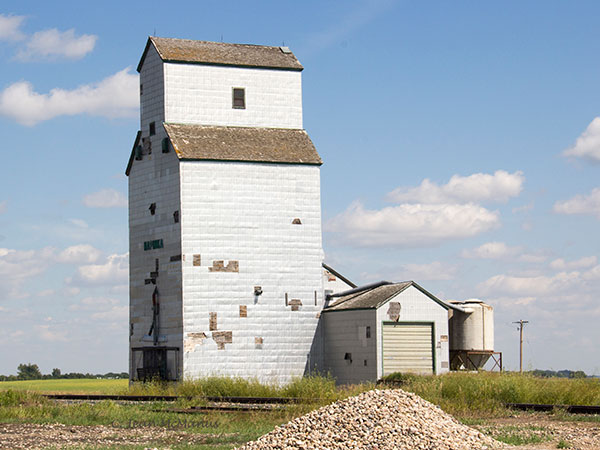
Ogilvie Grain Elevator / Manitoba Pool Grain Elevator
Napinka, RM of Brenda-WaskadaGrain elevators are often seen as iconic symbols of prairie Canada. At their peak, more than 700 elevators stood across Manitoba. Almost every agricultural town had at least one, sometimes several. But as Manitoba farms grew larger and the provincial road network improved, allowing big trucks to haul grain much farther than before, the need for numerous small wooden elevators declined, replaced by a few huge inland terminal elevators made of concrete or steel. Today, just over 100 wooden elevators remain in Manitoba, and roughly half now stand vacant.
Two wooden elevators at Napinka date from the “glory days” of wooden elevators in the 1920s. The older was built around 1923 for the Ogilvie Milling Company. Some four years later, a local association of farmers asked Manitoba Pool Elevators to construct an elevator on their behalf. When Ogilvie was taken over by Pool in 1959, the two structures were redesignated as “A” (the slightly newer Pool elevator) and “B” (the original Ogilvie).
Both elevators closed in July 1984 and were sold to local farmers for private grain storage. Used until 2000, they have stood vacant ever since, and rumours suggest demolition may be looming.
1931
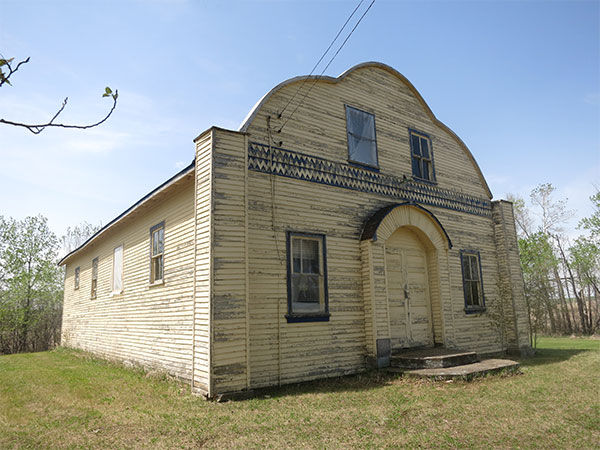
Ukrainian National Home
Ruthenia, Municipality of RossburnCommunity halls were once the epicentre of rural Manitoba life, being the venue for weddings, dances, concerts, meetings, political gatherings, school events, agricultural workshops, and holiday celebrations. More than just buildings, they embodied the ethnic, religious, and settlement histories of their districts. Ukrainian, Icelandic, Mennonite, and multi‑ethnic farming communities all built halls that were often the only large indoor gathering spaces, and many remain among the oldest public buildings in rural Manitoba.
Within this landscape, Ukrainian National Homes were distinctive. Patterned on social institutions in Ukraine, they were designed for cultural‑educational societies and typically included an auditorium, stage, and meeting rooms. They often housed libraries, hosted literacy and heritage classes, supported drama and music groups, and provided a gathering place for commemorations and social events.
These halls are now genuinely rare. The Manitoba Historical Society’s inventory identifies only seven surviving Ukrainian National Homes: in Angusville, Menzie, Oakburn, Ruthenia, Sandy Lake, Tolstoi, and Winnipeg. Six stand in urban or semi‑urban settings where new uses are feasible.
The seventh, at Ruthenia, built in 1931 south of Riding Mountain National Park, is the most vulnerable. The community it once served has largely dispersed, leaving few opportunities for sustained use. As a result, its long‑term survival is uncertain. Relocation to a museum — where its original cultural function could be interpreted and preserved — may offer the best future for this historically significant building.
1962
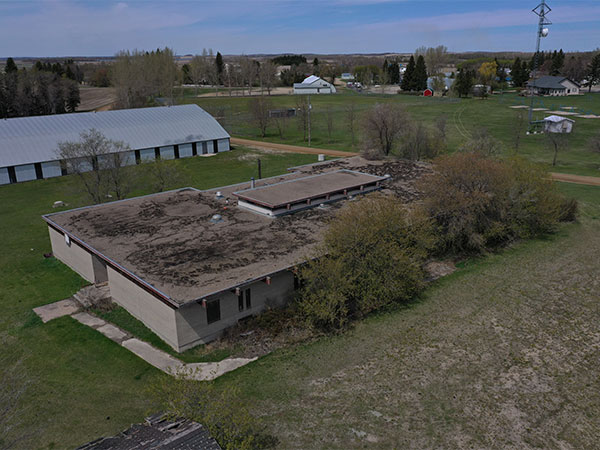
Mariapolis Collegiate
Mariapolis, Municipality of LorneThis one-storey, flat-roofed, brick structure, with curious wooden ceiling beams poking out at regular intervals, is an early work by internationally celebrated architect Etienne Gaboury. It initially served students from Mariapolis, St. Alphonse, Bruxelles, Swan Lake, Greenway and region until other disperse area schools were utilized instead (1967-1972). The building was then sold to Central Sportswear of Winnipeg and became a clothing factory (1974-1979). By 1980, it returned to its original function when purchased by the Swan Lake First Nation for nursery school, kindergarten, and grades one to eight. Renamed Indian Springs School, it operated until the early 1990s, when classes were relocated to a school on the First Nation.
The building, with cinderblock rooms, those unusual, beamed ceilings and clerestory windows (placed high to flood space with natural light while maximizing wall space), has been vacant for decades. Trees and bushes are encroaching the structure, including the decorative brick screen at its front entrance. Water is pooling inside.
While this structure’s material, ample interior space and community location are assets—not to mention its place within the Gaboury canon—time is against it in its current, wasting state.
1970-1971
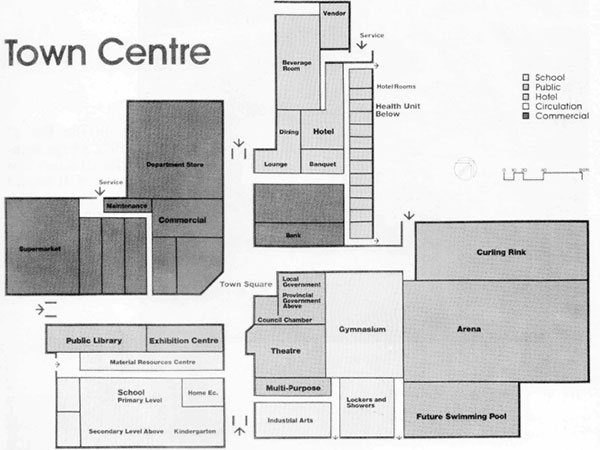
Leaf Rapids Town Centre Complex
Leaf RapidsThe difficulties of the Town of Leaf Rapids have been in the media recently—wildfire and the effects of the 2002 Ruttan Mine closure, the exodus of residents, home abandonment, businesses closures, reduction of health services, shortage of work and even shortage of food. Since 2019, Leaf Rapids has been without a mayor or town council.
The town itself is an at-risk heritage resource. Its cutting-edge design in the 1970s was initiated by the Provincial government through the Leaf Rapids Development Corporation, intended to promote a new interactive mining community that retained and optimized the natural setting, had a system of pedestrian walkways and curvaceous residential streets embracing a town centre building, essentially a roofed downtown.
The Leaf Rapids Town Centre, designed by celebrated architect Les Stechesen, remains intact. Inside, it is a relic of 1970s interior design and reminds us it was innovative to have as one complex, a hospital, school, library, post office, hotel, restaurants, stores and facilities like an arena and curling rink. It was not unusual for international delegations to visit and study the town as an example of efficient, attractive urban design in a remote and challenging (subarctic) environment.
The Leaf Rapids Town Centre remains the heart of the community despite its ageing infrastructure and that many of its businesses and amenities are gone. Its continuance depends on the town’s survival as much as the town depends on it. Any viable future, it seems, would require substantial intervention by government and/or other parties.
1975-1976
Multi-Family Housing Complex
738 Nassau Street South, WinnipegOn a quiet street facing a bright, open field stands a modernist public housing complex designed by renowned architect Gustavo Da Roza, best known for designing the Winnipeg Art Gallery. It is from a time when he headed the Canadian Housing Design Council and was being nationally recognized for his affordable housing and low energy buildings.
The long, lateral, white-painted cinder-block structure—its top (second) floor spanned by suspended sunscreens and its main floor dotted with colourful, rectangular panels—is of human scale and maximizes the light and open space that all its units face. It was still serving tenants when Manitoba Housing, Addictions and Homelessness listed it among its capital projects, specifically to be demolished for a new build, likely for larger, taller construction.
Because of its good design, performance and lineage, this housing complex is deserving of consideration for rehabilitation rather than demolition. There is precedent for refitting public buildings, preserving the existing infrastructure while making improvements up to contemporary performance standards. Second sober thought would give this unique public asset a chance, maybe its tenants a familiar place to return to, and could enable the continuance of a distinctly Manitoba story.
1977-1978
“The Wall” Art Installation
Portage Avenue & Main Street, Winnipeg“The Wall,” a sculpture by noted Manitoba artist Bruce Head, forms the inner facade of the circular underground walkway beneath Portage and Main. Commissioned as public art for that space in the late 1970s, it is the largest cast in concrete work by an artist in Canada. It measures 127 metres around and stretches floor-to-ceiling, a chunky, profusion of hundreds of one-of-a-kind cut-out shapes, resembling fossils, marine life, birds, stars, human figures or just strange forms.
The future of this unusual relief sculpture has come into question as the City of Winnipeg considers decommissioning the underground concourse. Fearing its loss, Head’s widow, Judy Watiuk, with the University of Manitoba’s Faculty of Architecture, New Media Manitoba and Studio Lab xR, spearheaded its digital replication using laser imaging technology for eventual viewing through virtual reality. This is a new kind of recording and a different personal interaction with the piece.
But what about the physical, tactile sculpture—all 52 panels moulded and manufactured on-site, a testament to when art was funded for integration into new public building projects? There is no substitute for the minutes-long walk around the art piece. Could mere salvaged parts convey its magnitude and majesty? Or will the wall be buried, a relic for future archaeologists?
Check out the MHS endangered structures lists for:
2019 | 2020 | 2021 | 2022 | 2023 | 2024 | 2025 | 2026
For further information on other historic sites around Manitoba, visit the Historic Sites of Manitoba page on the MHS website.
We thank Gail Perry, Gordon Goldsborough, and Ken Storie for providing information used here.
Page revised: 23 June 2026