
 |
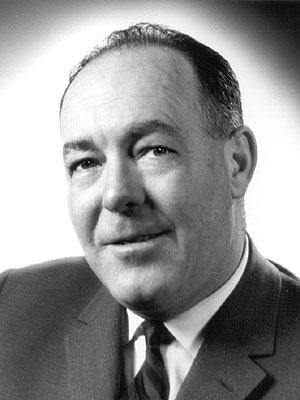
Harry Clare Pentland
|
Economist, professor.
Born near Justice on 17 October 1914, son of farmer Harry McVetie Pentland (?-?) and schoolteacher Mary Emma Fleming (?-?), his great-great-grandfather, an Ulster-Scot hand-loom weaver, emigrated to Canada from County Down, Ireland in 1821, settling first at Amherst Island, near Kingston, Ontario, where he practiced the dual vocations of farmer and weaver. His son, John, continued the agrarian-artisan tradition, becoming a carpenter. In 1843, the family moved to homestead in the Huron Tract, eight miles north of Goderich.
John’s son (Clare’s grandfather), Thomas, continued the westward move to the frontier, homesteading near Justice in 1881 where he combined farming with blacksmithing. This was the limit of the westward movement. The Pentland family became well established in the Elton municipality around Justice, and a Pentland has been Reeve of the area for a good part of its political history. It was there that Clare’s father grain-farmed and began his trucking business. While Clare was still a child, his family moved to Brandon to develop the business, largely in shipping cattle to the packers.
He grew up in Brandon, graduating from the Brandon Collegiate in 1931 and the Brandon Normal School in 1933. This was followed by three years of teaching at Whirlpool School (1933-1936) and at Erickson. He returned to Brandon College in 1936 and four years later, he graduated with a BA in Economics. While he attended college, he worked as an attendant at the Brandon Mental Hospital. It was also at the hospital that he met a young nurse Harriet Lilian “Hattie” Brook (1915-2012), who was later to become his wife. The following summer found him working as a brakeman on the Canadian Pacific Railway running between Brandon and Broadview.
The outbreak of the Second World War did not immediately interrupt his renewed educational program. From 1940 to 1942, he attended the University of Oregon where he obtained an MA degree in Economics. Almost immediately after completing his thesis in the early summer of 1942, he enlisted in the Army and while undergoing training in British Columbia married Harriet on 30 November 1942 in Vancouver. After officer training near Victoria and artillery training at Brandon and Brockville, he went overseas in February 1944 where he was transferred to the infantry as an education officer. He returned to Canada and to university, this time in Toronto, in the spring of 1946, under the Veterans Assistance Program and by 1948 completed all the requirements but the thesis for his PhD. He lectured briefly at Toronto, from 1947 to 1949, before returning to his native province as Assistant Professor of Economics at the University of Manitoba in 1949. He remained at Manitoba for the remainder of his career. Finally, the thesis was presented and defended late in 1960 and the degree conferred in 1961.
In 1962-1963, he spent a sabbatical in Cambridge, England. Again in 1969-1970, he spent a sabbatical in England, this time at the University of Sussex working on parish population studies. Unfortunately, failing health prevented him from completing this work and further refining and developing the ideas introduced in his 1965 paper to the Third International Conference on Economic History in Munich.
Despite his pursuit of historical demography in the 1960s, Pentland was also able to research and write his second major and influential unpublished manuscript, “A Study of the Changing Social, Economic, and Political Background of the Canadian System of Industrial Relations,” commissioned by the federally-appointed Task Force on Labour Relations. The 1960s were intensely productive years for Pentland. In addition to his population research and Task Force report, he also pursued his interest in technological change, producing three major reports for both provincial and federal agencies on skills, training and technological change plus a number of lesser reviews on related issues.
He served as President of the Manitoba Historical Society (1963-1965) and the Manitoba Record Society. In 1970, the Society awarded him its Manitoba Centennial Medal.
Heart problems plagued the last ten years of his life, robbing him of his stamina, a terrible frustration for a man so dedicated to his teaching and his work. Yet despite this he shouldered a heavy administrative load in university affairs, as a member of Senate (1963-1966, 1969-1976) and as a member of the Board of Governors representing the Senate (1973-1976). He also served on numerous university and Faculty Association committees as well as continuing to teach, write and research.
He died at Winnipeg on 13 October 1978, survived by his wife and their three sons.
Marriage registration [Henry Herbert Moretie Pentland, Mary Emma Irene Fleming], Manitoba Vital Statistics.
Birth registrations [Harry Clare Pentland, Harriet Lillian Brook], Manitoba Vital Statistics.
Marriage registration [Harry Clare Pentland, Harriet Lilian Brook], British Columbia Vital Statistics.
Obituary [Harriet Lilian Pentland], Winnipeg Free Press, 16 June 2012.
This page was abstracted from the Introduction to Paul Phillips’ edition of Pentland’s Labour and Capital in Canada 1650-1860.
We thank Nathan Kramer for providing additional information used here.
This page was prepared by Gordon Goldsborough.
Page revised: 27 May 2025
Memorable Manitobans
This is a collection of noteworthy Manitobans from the past, compiled by the Manitoba Historical Society. We acknowledge that the collection contains both reputable and disreputable people. All are worth remembering as a lesson to future generations.
Search the collection by word or phrase, name, place, occupation or other text:
Custom SearchBrowse surnames beginning with:
A | B | C | D | E | F | G | H | I | J | K | L | M | N | O | P | Q | R | S | T | U | V | W | Y | ZBrowse deaths occurring in:
1975 | 1976 | 1977 | 1978 | 1979 | 1980 | 1981 | 1982 | 1983 | 1984 | 1985 | 1986 | 1987 | 1988 | 1989 | 1990 | 1991 | 1992 | 1993 | 1994 | 1995 | 1996 | 1997 | 1998 | 1999 | 2000 | 2001 | 2002 | 2003 | 2004 | 2005 | 2006 | 2007 | 2008 | 2009 | 2010 | 2011 | 2012 | 2013 | 2014 | 2015 | 2016 | 2017 | 2018 | 2019 | 2020 | 2021 | 2022 | 2023 | 2024 | 2025 | 2026
Send corrections and additions to this page
to the Memorable Manitobans Administrator at biographies@mhs.mb.caCriteria for Memorable Manitobans | Suggest a Memorable Manitoban | Firsts | Acknowledgements
Help us keep
history alive!