
 |
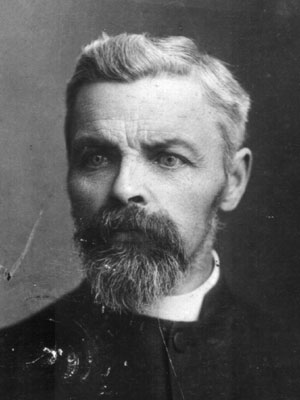
William Alfred Burman
|
Cleric.
Born at Yorkshire, England, he was persuaded at the age of eighteen by Reverend Richard Young of St. Andrew’s to come to Canada. He stayed at St. Andrew’s for a time and then entered St. John’s College where he took an Arts degree and studied theology. He was ordained deacon in 1879 and in that year was sent to the Sioux Reserve near Griswold to establish a mission. In 1880, he was married to a daughter of HBC Factor Samuel Taylor. They had one adopted son, Walter Burman.
He continued in his ministry to the Sioux for ten years, became fluent in the Sioux language and very knowledgeable in the Indigenous work of the Church. He was for many years convener of the special committee of the Provincial Synod of the Anglican Church of Indigenous missions. He was the first rural dean of Brandon, appointed in 1886. He organized and was the first head of the Rupert’s Land [Indian] Industrial School at Middlechurch (1889-1893).
From there he went to St. Peter’s mission, Selkirk Avenue, Winnipeg, which soon became a flourishing parish. Failing health forced him to give up parish work, and in 1903 he was appointed steward and bursar at St. John’s College, where he had for some time been lecturing in botany and Biblical literature. He had a wide reputationas a botanist and was for many years examiner in botany for the University of Manitoba. He was the founder of the Forestry and Horticultural Association of Manitoba which, among other things, promoted the planting of shelter belts around prairie farmsteads. He served as MHS President from 1899 to 1901.
He died at Winnipeg on 30 January 1909 and was buried in the St. John's Cathedral Cemetery. There are papers at the Rupert’s Land Archives and at the Archives of Manitoba.
His articles for the Manitoba Historical Society:
The Sioux Language
MHS Transactions, Series, No. 5, Read 1883The Present Status of Natural Science in Manitoba and the Northwest
MHS Transactions, Series 1, No. 55, Read 14 July 1900
Pioneers and Early Citizens of Manitoba, Winnipeg: Manitoba Library Association, 1971.
Obituaries and burial transcriptions, Manitoba Genealogical Society.
This page was prepared by Gordon Goldsborough.
Page revised: 3 February 2023
Memorable Manitobans
This is a collection of noteworthy Manitobans from the past, compiled by the Manitoba Historical Society. We acknowledge that the collection contains both reputable and disreputable people. All are worth remembering as a lesson to future generations.
Search the collection by word or phrase, name, place, occupation or other text:
Custom SearchBrowse surnames beginning with:
A | B | C | D | E | F | G | H | I | J | K | L | M | N | O | P | Q | R | S | T | U | V | W | Y | ZBrowse deaths occurring in:
1975 | 1976 | 1977 | 1978 | 1979 | 1980 | 1981 | 1982 | 1983 | 1984 | 1985 | 1986 | 1987 | 1988 | 1989 | 1990 | 1991 | 1992 | 1993 | 1994 | 1995 | 1996 | 1997 | 1998 | 1999 | 2000 | 2001 | 2002 | 2003 | 2004 | 2005 | 2006 | 2007 | 2008 | 2009 | 2010 | 2011 | 2012 | 2013 | 2014 | 2015 | 2016 | 2017 | 2018 | 2019 | 2020 | 2021 | 2022 | 2023 | 2024 | 2025 | 2026
Send corrections and additions to this page
to the Memorable Manitobans Administrator at biographies@mhs.mb.caCriteria for Memorable Manitobans | Suggest a Memorable Manitoban | Firsts | Acknowledgements
Help us keep
history alive!