Timeline...
1870 - 1879

The
World
On June 25 and 26, 1876 at the Battle of Little Bighorn, June 25 and
26, a combined Lakota, Northern Cheyenne and Arapaho force ,
overwhelmed the 7th Cavalry Regiment of the United States.
In 1876 Alexander Graham Bell successfully transmitted the first
bi-directional transmission of clear speech. An improved design for the
“telephone” was patented the next year.
Canada
In 1874 the newly created Northwest Mounted Police marched west from
Dufferin, Manitoba to southern Alberta
|
|
Manitoba
In 1870 the Province of Manitoba entered Confederation largely on terms
put forward by Louis Riel and his Metis provisional Government.
On July 31, 1874 the first Russian Mennonites arrived at Winnipeg on
the steamer International.
On December 4, 1878 the first freight by rail reached St.
Boniface.
The late 1870’s saw the first export of wheat from the prairies, the
irst grain elevator built in Niverville and steamboats service
established on the Assiniboine beween Winnipeg and Fort Ellice.
|
Turtle Mountain
& the Souris Plains
By 1870 the big Bison herds were gone from the region, and Metis
hunters, who continued to be mainly based in the Red River settlement,
were forced to take their annual hunt farther south and west. Only
scattered itinerant groups of Assiniboine and some refugee Sioux from
the U.S. remained in the area.
1873
The Boundary Commission was established and began creating a trail
westward that was to be well used for the next next decade.
B.B. La Riviere who worked for the Boundary Commisssion opened a
trading post and stopping house at Wakopa on the trail that the survey
had established.
1875
A Sioux Reserve was established at the junction of the Assiniboine and
Oak Rivers. This is the Oak River Reserve although it is often
referred to as Sioux Valley. Today it has a population of around
1,000 people, most of whom are Santee. .
1876
Battle of Little Bighorn
The western Sioux, Oglallas and Hunkpapas, along with the Santee
realized by 1870, that the Americans intended to take their homeland
regardless of the terms of the Laramie Treaties of 1851 and 1868.
War with the U.S. Army followed with the Sioux winning two great
victories against General Crook and General Custer. But, then
fortunes changed and the Sioux began the long migration to Canada in
1876.
According to L.C. Lockwood, a civilian Scout and Custer’s Troops in
1876, following the Custer Battle, one band of Sioux escaped to Turtle
Mountain camping on the Canadian side beside Lake Flossie.
From there they sent raiding parties into the Dakotas to attack army
units and American settlements. To counteract his, the U.S. 7th
Cavalry was sent north to patrol the Canadian border along the Souris
River and Turtle Mountain. These attacks by the Sioux continued
for two years. In 1878, the U.S. Army still kept pickets at Fort
Lincoln (present day Bismarck) on the Missouri River, as the Sioux from
Turtle Mountain had attacked the fort several times. It appears
that this band of Sioux, probably Hunkpapas, maintained this Turtle
Mountain stronghold until 1885 and probably later.
By the end of 1876 more than 7,000 Sioux had crossed the Medicine line
into Canada.
1877
The Santee Sioux residing near Turtle Mountain, requested a reserve
from the Manitoba Lieutenant-Governor. This was granted them on
their promise not to aid the American Sioux, who were still at war with
the American authorities, and in 1878 they received a reserve north of
Pipestone near Oak Lake. Today this is called the Oak Lake
Reserve (Canupawakpa) .
In the same year a Turtle Mountain Reserve (IR#60) was
established for a group of Wapheton Sioux and some Hunkpapas from Lake
Flossie. This reserve operated until 1907 when its residents were
moved to the Oak Lake Reserve. In 1908 then the Oak Lake Reserve
included Waphetons, Santee, a few Hunkpapas and some descendants of
Chief Inkpaduta (Santees outlawed before 1862 by the main Santee
Nation).
1879
Some of the Manitoba Sioux joined one of the last Metis buffalo hunting
parties, a group of 500 men, women and children. While hunting along
the Souris River in Dakota they are attacked by General Miles and the
American Cavalry. The Sioux were forced to withdraw to Canada but
the Metis were taken prisoner. The American authorities then
tried to settle the Metis permanently in Turtle Mountain and on the
American side. This may have been the beginning of a Metis
settlement that exists in Turtle Mountain today.
The settlement of the Boissevain area began in 1879 with the arrival of
the Brondgeest and Livingstone families in the Whitewater area.
A group of Ontario settlers started the settlement of Old Deloraine to
the north of Turtle Mountain.
Two settlements appeared on the Souris River. A Plum Creek
settlement was started by Squire Sowden which became the present town
of Souris. North east of Hartney a small village called Malta
began. Malta had a blacksmith shop, a boarding house and a
store, but in 1889 when the C.P.R. built on the south side of the
river, the residents all moved to form the village of
Menteith.
A. Sharpe had settled in the Whitewater area operated what is said to
be the first real farming operation in the region.
W.F. Thomas camped at Sourisford. After filing for a homestead, he
established a ferry crossing on his property that was to be well used
by the many settlers who soon followed.
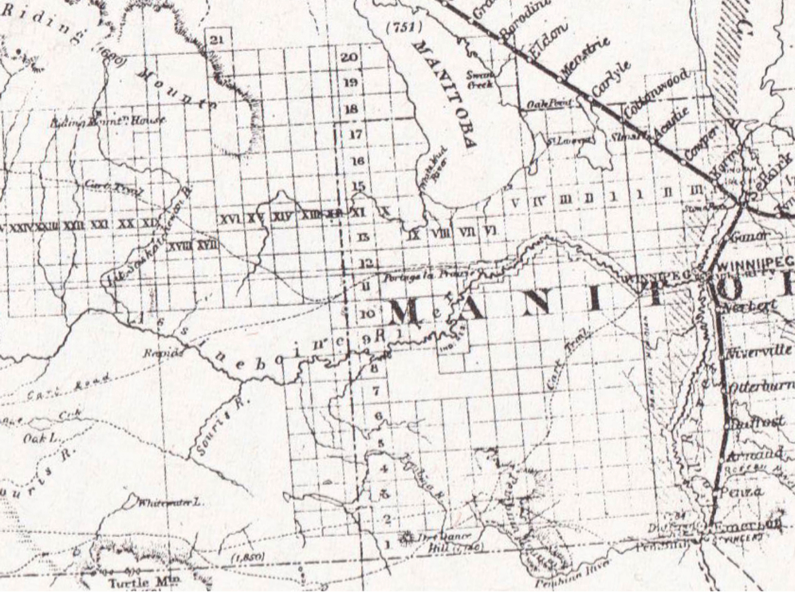 Route
For the CPR
Route
For the CPR
By Section, Township & Range,
Studies in Prairie Settlement, John
Langton Tyman
Brandon
University, 1972 P 34
In 1877
the C.P.R. was planning a northern route and southwestern
Manitoba had not yet been surveyed.
|
|


