Timeline...
1850 - 1869

The
World
1861-65: Civil War in the U.S.
1848-52: Potato Blight causes extensive crop failures in Ireland.
Canada
1867: Confederation united four British Colonies to create Canada. From
the outset, leaders like John. A. MacDonald envisioned a Canada that
stretched westward across the Prairies to the Pacific.
|
|
Manitoba
1859: Expeditions by Capt. Palliser and Henry Youle Hind explored the
Northwest Territories to examine the suitability of the region for
agricultural settlement.
In 1869, the Hudson's Bay Company (HBC) sold Rupert's Land to the
Dominion Government of Canada, increasing the government's land
five-fold.
1869: Louis Riel led a group of Metis in the formation of a
provisional government.
|
Turtle Mountain
& the Souris Plains
The Red River Metis on their annual bison hunt would often pass north
of Turtle Mountain.
Settlement & Exploration
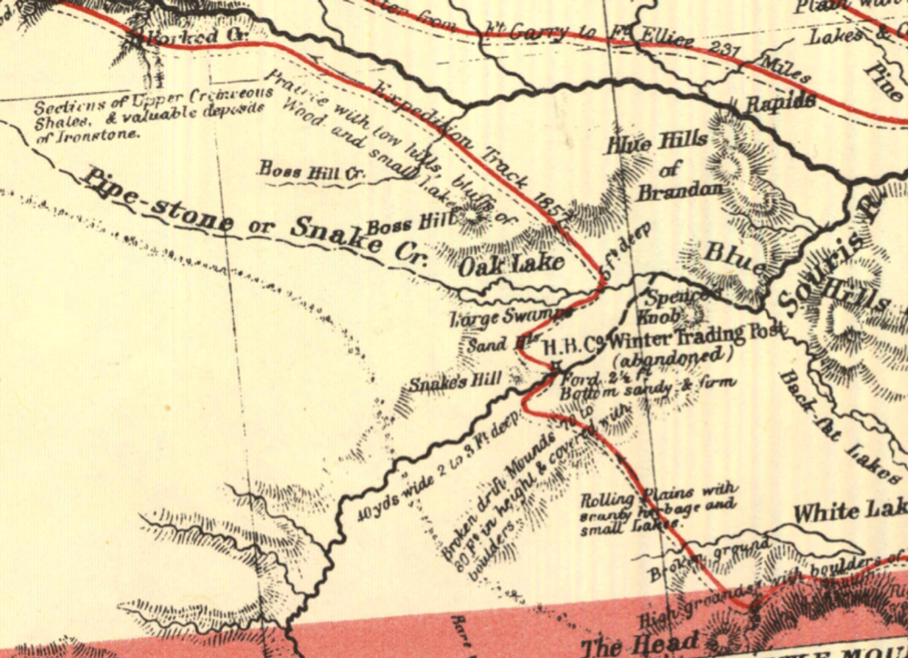 This map
prepared by the Palliser Expedition shows the region about
1859.
This map
prepared by the Palliser Expedition shows the region about
1859.
http://www.flickr.com/photos/manitobamaps/2211818555/
The
British North American Exploring Expedition, commonly called the
Palliser Expedition, explored and surveyed the open prairies and rugged
wilderness of western Canada from 1857 to 1860. One purpose was to to
assess the regions potential for agricultural settlement
1854
In 1854, Cuthbert Grant died and his fort was operated by relatives
until 1861. One of these relatives was his grandson, Thomas Breland who
later was the first to homestead in the Grande Clairiere district. By
this time, business for the two remaining forts was greatly reduced and
the Metis operating Fort Grant were now making an attempt to raise
livestock and a few small crops. These were the first homesteaders in
the area and included:
J. LEVEILLE - 34-6-24
A. BRELAND - 30-6-24
A. COUTEAN - 5-6-24
A CAUPHINAIS - 6-7-24
1856
Fort Desjarlais was burned to the ground, either by a prairie fire of
the Sioux. Some of the people who worked in the fort coninued to
live in the region, taking up farming.
1862
In 1862, the Minnesaota Uprising led by Yankton Sioux resulted in the
death of more than 600 Minnesota settlers.
Chief Little Crow and his warriors camped in the Turtle Mountains in
Dakota Territory. Here they were visited by Sitting Bull, a
Hunkpapa Medicine Man.
1863
After participating in the Minnesota Uprising, the outlaw Chief
Inkpaduta fled into Dakota Territory and on December 4th, 1863 he was
driven north into Canada by General Sully. He made his
headquarters on Turtle Mountain and from the Canadian side made
repeated raids into the United States until 1868.
In the autumn of 1863, several hundred Sioux arrived at Turtle
Mountain, along with their white prisoners. They were in a state
of starvation, and failing to get much help from the Canadian
Authorities, they made raids into the U.S. to hunt buffalo.
Some of these Minnesota Yankton Sioux settled along the Souris River.
These Indian villages lasted until about 1870 when the Sioux were
restricted to an area about 6 miles west of Grande Clairiere and south
to the Souris River. Later, when the white settlers began to arrive,
this reservation was shifted to the North along the Pipestone Creek -
thus the establishment of the present Oak Lake Sioux Reservation.
The American authorities sent a priest, Father Andre, to a large Sioux
camp on the Souris River (west of present day Lauder). His
mission is to persuade this band of Sioux to return home. Father
Andre reported that the Sioux did not seem to care whether they lived
or died, but they refused to return to the United States.
1865
In 1865 according to a member of the Oak Lake Sioux reserve, the battle
between the Cree and the Sioux took place in a group of sandhills to
the north east of the village of Deleau and ended only when one of the
chiefs was killed. However, in spite of great suffering the
Dakotas tried to obey the laws of Grandmother’s country (Canada) and
eventually were given small reservations. In this regard the
Canadian authorities refused to consider Sioux claims to land ownership
north of the 49th parallel and this meant they would not receive treaty
money from the Canadian government.
1868
An International Meeting of Indians was held in Turtle Mountain.
The meeting was chaired by the Oglalla Chief, Crazy Horse, who pleaded
for the unification of all tribes to defeat the whites. These
pleas were rejected by the other tribes..
1869
In 1869, some of the Metis from the "Red River Rebellion" arrived in
the Oak Lake - Grande Clairiere sandhills area. Along with the Metis
living there, the Metis population was increased to about 20 families.
By this time, the Assiniboine had all migrated from the Souris.
Their numbers greatly reduced by smallpox they followed the few
remaining buffalo west. Eventually they were placed on
reservations in the Moose Mountains and in the foothills of the
Rockies. Of the 10,000 that Alexander Henry estimated in 1806,
only a few hundred remained.
|
|


