Timeline...
1800 - 1849

The
World
1805-06: Lewis and Clark lead an expedition across North-western
United States to the Pacific Ocean.
Canada
The War of 1812 – 14.
In what is essentially a war between The United States and Britain,
Canada successfully repelled an American invasion with the help of
native tribes. Many years later Sioux warriors, descendants of those
who fought, still treasured medals given for service the British Crown.
|
|
Manitoba
1812
The beginning of agricultural settlement in Manitoba with the
arrival of Selkirk Settlers. This would lead to the establishment of
Winnipeg as the commercial centre of the region.
|
Turtle Mountain
& the Souris Plains
As the bison retreated from the Red River Valley Metis hunters
established highly organized expeditions to seek out the herds. Their
route took them through the Turtle Mountain-Souris Plains region.
Wintering communities were sometimes established in the region.
The establishment of a succession of trading posts in the Hartney –
Lauder region would eventually spur efforts at agriculture. There is
evidence that, in the Hartney – Grande Clairiere district, some people
involved in the fur trade made the transition to farming and stayed in
the region when the fur trade ended. As an example, in the 1930’s at
least two Hartney area families could trace their roots back to Fort
Desjarlais.
1800
The Assiniboine were 28,000 strong across Manitoba with more than
10,000 in the Turtle Mountain region alone.
A Northwest Company trader, Alexander Henry Jr., made his first trip
down the Souris River from the Northwest Company Fort La Souris at the
junction of the Souris and Assiniboine Rivers. He travelled down the
river to about the present day town of Souris. From here he
traveled across country to Fort La Bosse, near Virden, on the
Assiniboine River where he engaged in the buffalo hunt.
1806
After about 1806 it appears that the Northwest Company lost interest in
the Souris but American traders and Independents soon took their place
on that river.
Alexander Henry Jr. travelled across the Souris plains on his way south
to the Mandan Villages.
He carried the usual trade goods, tobacco, beads, knives, muskets; and
in his case, a good supply of liquor. On July 15th he stopped for the
night at the Fort Ash site. During the trip upriver he mentioned
passing several Assiniboine camps of about 70 tents, and after visiting
Turtle Mountain he estimated the Assiniboine population at about
10,000. While passing along the Souris, Henry was careful to put night
guards on the horses as the Assiniboine had the reputation of being the
greatest horse thieves on the prairies. Guards were also
necessary as Henry was carrying guns and ammunition to the Missouri
River Indians.
1807
Francois Jeanette, was born on the Souris River near the present day
city of Bottineau, North Dakota. His father, Justas, a French
Canadian, was a trapper on the Souris River and had lost his first wife
and son to the Gros Ventre raiders. He lived and worked in the
Souris Valley until 1905.
1810
The American Fort, north of Lauder, was built about 1810. The
size of its chimney mounds indicate that it was in operation for a
considerable length of time so we can speculate that it operated until
1828 when Cuthbert Grant was appointed “Warden of the Plains” and
instructed by the Hudson’s Bay Company to clear out all opposition
trading posts. These American posts were also used as a springboard to
the reach the Assiniboine and Qu’Appelle River regions and it is known
that the Americans traded extensively on the Qu’Appelle.
1812
An American engineer, searching for a passage north from the Missouri
River, found a large Gros Ventre village at the intersection of the
Souris-Antler Rivers.
The following year warriors from this village scalped Francois
Jeannottes’ sister and he and his mother moved to Fort Garry.
However, a few years later, Jeannotte returned to the Souris River and
later worked in two trading posts above the 49th parallel.
It was about this time that the buffalo hunts began along the Souris
River. They were small for the first few years, just a few tents,
but by 1820 they would be large organized affairs.
1815
The Sioux wiped out the Gros Ventre Nations who were living at this
time at the junction of the Souris and South Antler Rivers.
1820
A Sioux-Assiniboine battle took place just east of Whitewater Lake.
Maria, daughter of Cuthbert Grant, was born in 1820. She married Armand
Breland who played an important part in the trading posts on the Souris
River, and whose son, Thomas, would be one of the first
homesteaders in Grande Clairiere.
The first Metis buffalo brigade from Fort Garry crossed the Souris
River near present day Melita.
1824
Cuthbert Grant established Fort Grant on the Souris River near Hartney
in 1824.
1828
Cuthbert Grant was appointed “Warden of the Plains” and instructed by
the Hudson’s Bay Company to clear out all opposition trading posts.
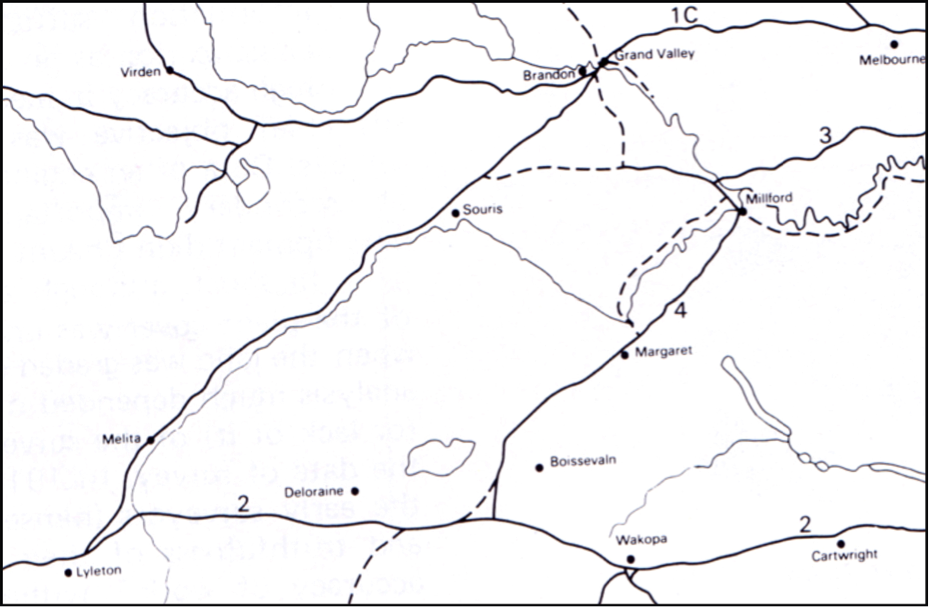 By
Section, Township & Range, Studies in Prairie Settlement, John
Langton Tyman
Brandon
University, 1972 P 18
1. C –
Saskatchewan Trail – Southern Branch
2.
Boundary Commission Trail
3. Yellow
Quill Trail
4. Bang’s
Trail beyond Millford
By
Section, Township & Range, Studies in Prairie Settlement, John
Langton Tyman
Brandon
University, 1972 P 18
1. C –
Saskatchewan Trail – Southern Branch
2.
Boundary Commission Trail
3. Yellow
Quill Trail
4. Bang’s
Trail beyond Millford
1831
The Sioux returned an Assiniboine attack moving east down the Souris
River into Manitoba. They turned north where they meet a Metis
Buffalo Brigade returning from the Moose Mountains.
The buffalo hunters, as usual, formed a circle with their cars and held
off the attackers. This attack took place to the west of Oak
Lake. In the same year, Sioux war parties forced the forts at the
mouth of the Souris to close.
1836
Fort Desjarlais was built in 1836 by Joseph Desjarlais, located on the
north bank of the Souris on Sec. 31, Tp. 5, Rge. 24, to the north west
of Lauder. Downstream about one kilometre is the location of the
older American Fort.
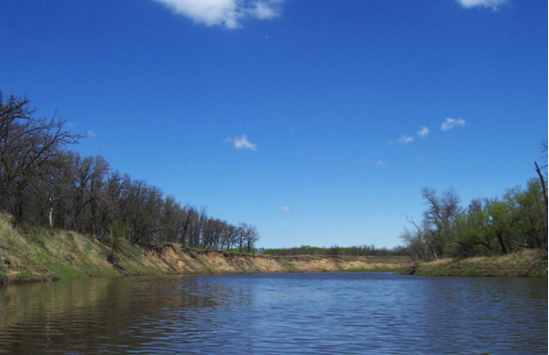
Site of
Fort Desjarlais, 1999
1838
In 1838 smallpox once again struck the Assiniboines who were now
reduced in numbers to less than 4,000 from the original 10,000.
1842
The Assiniboine population was greatly reduced by war and smallpox to
about 3,000. A local resident of Hartney, Mrs. De Pevre, whose
grandfather worked in the Souris River forts in the 1840’s, states that
her grandfather observed two Assiniboine villages in 1842 where
everyone was dead of smallpox.
1844
The Metis attack the Sioux during a buffalo hunt in the Souris River
area. Several Sioux are killed and they demand
compensation. A meeting between the two groups was held on the
plains and as a result peace was declared. It lasted until about
1849.
1849
A Sioux-Assiniboine battle took place along the river in 1849.
The site of this battle is SE Sec. 36, Tp. 5, Rge. 24.
In the same year a trading post operated very close to the site of
present day Melita.
|
|


