
 |
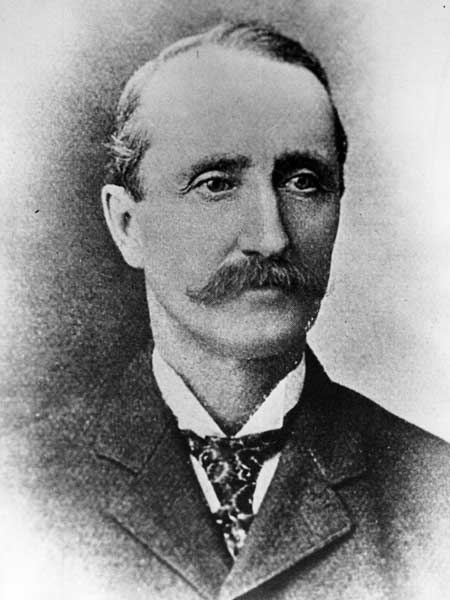
Robert Atkinson Davis
|
Teacher, hotelier, MLA (1874), MLA (1875-1878), Premier of Manitoba (1874-1878).
Born at Dudswell, Lower Canada (now Quebec) on 9 March 1841, he attended St. Francis College and became a school teacher. He and his brother spent several years after the American Civil War in the American Rockies. In 1870 he came to Winnipeg, arriving on 10 May while the provisional government was in control of the settlement. He bought George Emmerling’s hotel, renaming it Davis House. Its saloon became the social centre of the Ontario volunteers who came with the Wolseley Expedition, and Davis was able to expand his operations to include a barbershop, billiard parlour, and store. He soon became a spokesman for the newcomers in the village, who struggled with the Hudson’s Bay Company for control.
In 1873, he took the lead in drafting a bill to incorporate Winnipeg. Soon afterward he became a leader of the Patrons of Husbandry, using this group’s influence to gain election to the Legislative Assembly in an April 1874 by-election to replace Donald Alexander Smith. He soon became Provincial Treasurer under Marc Amable Girard and, in the unstable political situation of the time, assumed the premiership as leader of the Ontario faction in the House of Assembly. He was re-elected in December 1874.
Fluent in French, he persuaded the French faction that he supported French rights, and his ministry did uphold the system of dual education and maintain legislation limiting speculation in Métis lands, despite pressure to do otherwise. He lobbied successfully for the route of the transcontinental railroad to pass through Winnipeg rather than Selkirk. His government was responsible for the abolition of the Legislative Council in 1875. It also negotiated better financial terms with Ottawa.
Having in 1875 married an American resident of Illinois who did not move to Manitoba, Davis joined her and their child in the United States after his retirement from politics in 1878. The couple moved to Chicago in 1880, and Davis prospered in real estate speculation. In 1890, he was charged with breach of promise and, six years later, he separated publicly from his wife.
He died at Phoenix, Arizona on 7 January 1903. Some papers are at the Archives of Manitoba. He is commemorated by a plaque on Main Street, Winnipeg.
See also:
Historic Sites of Manitoba: Robert Atkinson Davis Plaque (Main Street, Winnipeg)
“Robert A. Davis, 1874-1878 ” by Ruth Swan in Manitoba Premiers of the 19th and 20th Centuries, edited by Barry Ferguson and Robert Wardhaugh, Canadian Plains Research Centre, 2010.
Robert Atkinson Davis by Ruth Swan, Dictionary of Canadian Biography XIII, pages 253-56.
Manitoba As I Saw It: 1869 to Date, With Flash-Lights on the First Riel Rebellion This book contains biographies ofsome prominent Manitobans in the early 20th century. It was written by Dr. John H. O’Donnell, and published by the Musson Book Company at Toronto in 1909. Most of those featured in the book were living at that time, so no information on death dates was provided. Where possible, these have been added to this online version. Online version 2008, Manitoba Historical Society. |
Dictionary of Manitoba Biography by John M. “Jack” Bumsted, Winnipeg: University of Manitoba Press, December 1999, 288 pages.
We thank Ruth Swan for providing additional information used here.
This page was prepared by Gordon Goldsborough.
Page revised: 15 December 2024
Memorable Manitobans
This is a collection of noteworthy Manitobans from the past, compiled by the Manitoba Historical Society. We acknowledge that the collection contains both reputable and disreputable people. All are worth remembering as a lesson to future generations.
Search the collection by word or phrase, name, place, occupation or other text:
Custom SearchBrowse surnames beginning with:
A | B | C | D | E | F | G | H | I | J | K | L | M | N | O | P | Q | R | S | T | U | V | W | Y | ZBrowse deaths occurring in:
1975 | 1976 | 1977 | 1978 | 1979 | 1980 | 1981 | 1982 | 1983 | 1984 | 1985 | 1986 | 1987 | 1988 | 1989 | 1990 | 1991 | 1992 | 1993 | 1994 | 1995 | 1996 | 1997 | 1998 | 1999 | 2000 | 2001 | 2002 | 2003 | 2004 | 2005 | 2006 | 2007 | 2008 | 2009 | 2010 | 2011 | 2012 | 2013 | 2014 | 2015 | 2016 | 2017 | 2018 | 2019 | 2020 | 2021 | 2022 | 2023 | 2024 | 2025 | 2026
Send corrections and additions to this page
to the Memorable Manitobans Administrator at biographies@mhs.mb.caCriteria for Memorable Manitobans | Suggest a Memorable Manitoban | Firsts | Acknowledgements
Help us keep
history alive!