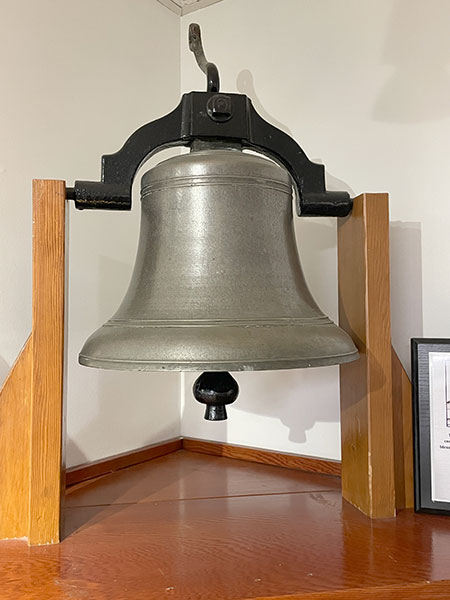

This Roman Catholic church on Pembina Highway in Winnipeg, a facility of the Archdiocese of Winnipeg, was designed by architect Roy Sellors and built in 1956. A bell at the church, blessed on 8 September 1860 by Archbishop Alexandre-Antonin Taché, was formerly on a school operated by the Grey Nuns on the east side of the Red River, opposite St. Maurice School on the west side. In 1897, the school was rebuilt on the west side of the river.
An honour roll inside the lobby of the church lists parishioners who served in the military during the Second World War, including some who were killed in the line of duty.
Bell at St. Vital Catholic Church (October 2026)
Source: Gordon GoldsboroughSite Coordinates (lat/long): N49.83030, W97.15235
denoted by symbol on the map above
Name
Service
Rank
Birth Date
Death Date
Aime Beauchamp
1 Corps Field Park Company, Royal Canadian Engineers
Sapper
6 October 1921
23 February 1943
Louis Laurent Hamelin
[RCAF Brandon]81 Squadron, Royal Canadian Air Force
Warrant Officer Class II
18 May 1920
23 March 1943
Metro Zytaruk
Cape Breton Highlanders, Royal Canadian Infantry Corps
Private
17 March 1923
29 September 1944
See also:
Memorable Manitobans: Roy Sellors (1913-2005)
Historic Sites of Manitoba: St. Maurice School (1639 Pembina Highway, Winnipeg)
Historic Sites of Manitoba: Joseph P. Borowski Memorial (1629 Pembina Highway, Winnipeg)
“St. Vital church, in Fort Garry has bell older than Canada,” Winnipeg Tribune, 3 February 1968, page 21.
We thank Wayne Chan for providing additional information used here.
This page was prepared by Jordan Makichuk.
Page revised: 5 October 2026
Historic Sites of Manitoba
This is a collection of historic sites in Manitoba compiled by the Manitoba Historical Society. The information is offered for historical interest only.
Browse lists of:
Museums/Archives | Buildings | Monuments | Cemeteries | Locations | OtherInclusion in this collection does not confer special status or protection. Official heritage designation may only come from municipal, provincial, or federal governments. Some sites are on private property and permission to visit must be secured from the owner.
Site information is provided by the Manitoba Historical Society as a free public service only for non-commercial purposes.
Send corrections and additions to this page
to the MHS Webmaster at webmaster@mhs.mb.ca.Help us keep history alive!