
Introduction | The Assiniboine | The Souris | The Little Saskatchewan | The Boundary Trail | Here & There



Introduction

| Welcome
to our exploration of the locations of River Crossings in Southwest
Manitoba. Prior to the building of railways, a traveller had few options. Many walked. “Shanks Mare” was the descriptive expression for that. If you had a horse, that made a trip much faster. If you had oxen, the trip would be much slower, but they could pull quite a load on a wagon or a red river cart. Whatever your circumstance, much of your trip throughout this land was relatively smooth going. No mountains. Marshes or swamps could be bypasses. Flat land as far as the eye could see, most days. But... Pioneer reminiscence is full of tales of crossing the streams. It could be a tricky procedure. But here again, nothing quite like the raging mountain streams to the west or the muskeg and rapids of the Canadian Shield. Fords 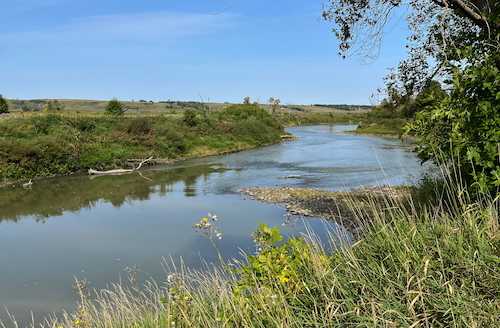 A shallow bend in the Assiniboine River west of Brandon. The river banks are low. A likely spot for a ford. Springtime was a special challenge. Currents could be strong and dangerous. There were mishaps. There were also innovative ways to tackle the problem. Wagons converted to makeshift boats. Horses forced to swim. Ferries A big advantage of established ferries over various improvised methods of crossing a river was the ability to transport heavy loads. A wagon could be taken across without unloading and re-loading. Herds of cattle could cross quickly. Ferries were essential for getting grain to market. 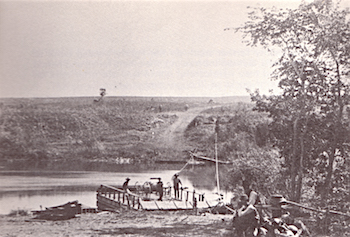 One of some 150 ferries
that once operated in Manitoba.This one at an
unidentified site on the Souris River.
The first ferries were basically rafts, powered by poles or long paddles, but most soon used a cable attached to a support on each side of the stream. Some were towed across by oxen or horses. As settlements grew private entrepreneurs developed ferries as a business. With the creation of provincial and municipal governments grants of $200 were offered to people willing to establish a ferry. Eventually municipalities took over, or established, ferry services. Although established ferry crossings generally became the site of a bridge this didn’t always happen. Some sites just didn’t mesh with the evolving settlement patterns and transportation routes. Bridges Ferries were functional and a great improvement over improvised crossings, but as soon as a town was established alongside a river (as many were) thoughts would turn to building a bridge. 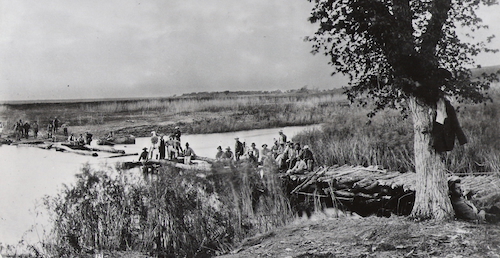 They were usually made of wood, starting with a series of pilings sunk into the river bed. A platform of planks provided the road bed. 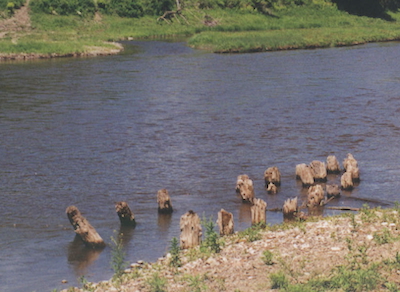 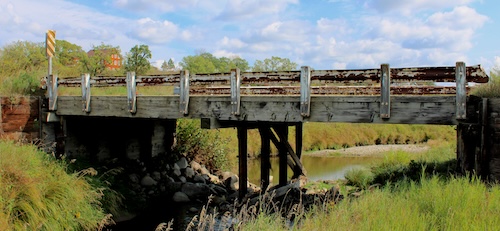 The second generation of bridges over Manitoba streams involved the use of concrete and iron. Our project reports on various styles as we proceed. 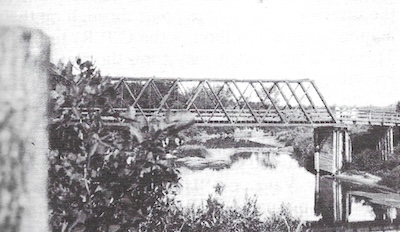 The first bridge over the Souris River near Treesbank. 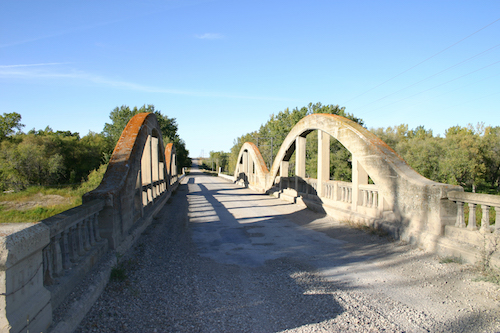 The second one was a bit more substantial and added a bit of style. This is a work of personal exploration that took decades to take this form. It started with the rivers...exploring them in a canoe. Finding access points for day trips led to an interest in the bridges are often convenient places to access the river - so I saw a lot of them. Inadvertently I learned about towns that used to exist along the rivers, and crossings that used to be used. That lead to an examination of local history books for more information. So... in short form... my interest began with exploring rivers and a personal look at sites. That process was very much aided by the advent of Google Earth which allowed discoveries that I hadn't found in person or in books. That brought me out to look at more sites. And so...this... |
