
| Pivotal
Events |
 |
 |

Timeline ... 1920 - 1929
The World The conditions imposed upon Germany after WW1 help trigger an economic collapse and political turmoil that results leads to the rise of Adolph Hitler and his Nazi Party. 1927: Charles Lindberg flies solo from New York to Paris. Canada Post-War adjustments are difficult. The “Roaring Twenties” though fondly remembered most correctly apply to the latter part of the decade. |
Manitoba 1920: The Manitoba Grain Growers’ Association becomes “The United Farmers of Manitoba.” It turned its attention to progressive farm legislation |
Arden and the R.M. of Lansdowne Some General Trends in the 1920’s Throughout the prairies communities erected various memorials commemorating the sacrifice and service of those who participated in the “Great War.” On farms and in businesses trucks were replacing horses for everyday tasks. Commercial travelers now use cars making them more flexibly mobile. This trend eventually led to the decline in demand for hotel rooms and of course a decline in rail passenger traffic. Many communities reached the peak of business expansion in the pre-war years. We see stores changing hands, closing - the same decline is seen in housing, again communities had expanded to the natural capacity. The adoption of a car-based transportation economy saw the expansion of car-based service – gas stations, auto repair shops. In recreation, tennis and cricket declined. Hockey continued to grow, as did curling. Radio helps connect remote hopuseholds to the rest of the world. Roads replace Rails…. 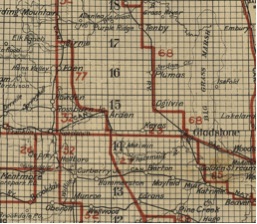 Automobile Road Map of Manitoba (1924) Emmett, A.C. Automobile Road Map of Manitoba [map]. 1:760,320. Winnipeg: Stovel Company Ltd., 1924. Image Courtesy of University of Manitoba Archives & Special Collections (Morris Block fonds, MSS 207, A.05-43) www.umanitoba.ca/libraries/units/archives/collections/com 1920 Lansdowne boundaries amended – to their present form. New primary school building erected – to accommodate additional students resulting from the school consolidation. 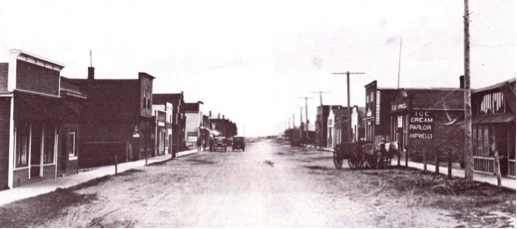 Arden in the early 1900's 1921 A by-law is passed to establish a fire hall. Robert Milne of Mekiwin is nominated to the candidature for the Na¬tional Progressives. He is elected by a 4,800 vote majority in the federal election. Sinclairville School District #2063 formed. It operated until about 1966. 1922 Tenders are called by D. Paterson, Sec., Berton, for the erection of a one-roomed school on SE 4-14-12. The General Store of the Berton Trading Co. burned to the ground in November. Owners Mr. and Mrs. Green, who lived in the rear end of the store, lost complete contents of store and house. 1923 Council is to apply to the Good Roads Board for assistance in repairing bridges due to serious spring flood¬ing and run-off. Seven major bridges were seriously af¬fected. New Railway Station built in Arden. The village of Berton is re-named Helston as the name Berton was also in use in Alberta. 1924 Council hired a permanent Health Officer with as¬sistance from the Village of Arden and dispensed with the service of a nurse. The Council took over title to the Arden skating and curling rink. Council along with Langford & Rosedale expressed their disapproval of the opening of beer depots in Neepawa. Letter postage rates were reduced to 2 cents. E.G. Hipwell, Arden storekeeper, founded an industry that produced fruit flavored syrups. Taken over by his son, Justin, it later became Hip’s Fruit Flavored Syrups and its products are marketed across Canada. 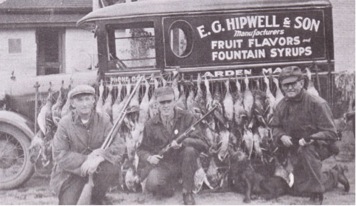 J.R. Foreman, Justin Hipwell, Ben Bradley 1925 Dominion Rust laboratory set up in an effort to isolate rust-resistant varieties of wheat. The Patriotic Society was granted $700.00 towards the war memorial. 1926 Council took title to the sports grounds, east of Arden and put it under management of the Arden Village district. George Stockdale was entrusted with the building of the office vault for $500.00 to $600.00. The War Memorial was unveiled on August 22. 1927 Congregations of St Andrew’s Presbyterian and Methodist unite. Services held in St. Andrews. The minister lived in the Methodist parsonage. Mekiwin Cemetery established. A crow’s eggs bounty is set at one cent per egg and one cent for each leg. Any teacher could issue certificates for the same. The official opening of the new hall at Keyes held in November. 1928 The stained glass War Memorial window is unveiled and dedicated at Keyes Anglican Church in June. 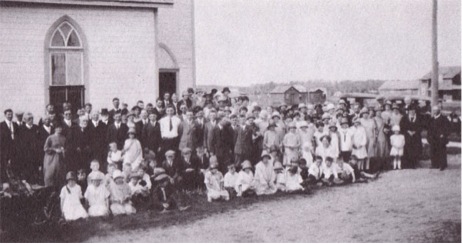 Inaugural Session of the United Church 1927, after Union. |