Timeline...
1920 - 1929

The
World
The conditions imposed upon Germany after WW1 help trigger an economic
collapse and political turmoil that results leads to the rise of Adolph
Hitler and his Nazi Party.
1927: Charles Lindberg flies solo from New York to Paris.
1929: The Stock Market crash signaled the beginning of the Great
Depression.
Canada
Post-War adjustments are difficult. The “Roaring Twenties”,
though fondly remembered, most correctly apply to the latter part of
the
decade.
|
|
Manitoba
1920: The Manitoba Grain Growers’ Association becomes “The
United Farmers of Manitoba.” It turned its attention to
progressive farm legislation
|
Turtle Mountain
& the Souris Plains
Some General Trends in the 1920’s
Throughout the prairies communities erected various memorials
commemorating the sacrifice and service of those who participated in
the “Great War.”
On farms and in businesses trucks were replacing horses for everyday
tasks.
Commercial travelers now use cars making them more flexibly mobile.
This trend eventually led to the decline in demand for hotel rooms and
of course a decline in rail passenger traffic.
Many communities reached the peak of business expansion in the pre-war
years. We see stores changing hands, closing - the
same decline is seen in housing, again communities had expanded
to the natural capacity.
The adoption of a car-based transportation economy saw the expansion of
car-based service – gas stations, auto repair shops
In recreation, tennis and cricket declined. Hockey continued to grow,
as did curling.
Radio helped connect remote households to the rest of the world.
Between the Wars
The excitement of the War years, the re-aligning of values in the light
of the necessity for personal survival on the battlefields and for
national victory, had a disrupting effect on the puritanical taboos by
which Manitoba servicemen were influenced before enlistment.
As the home folk sang with the returning men "How ya goin' to keep 'em
down on the farm after they've seen Paree?" they realized that, if this
were to be accomplished, they must not be too critical of the changed
and more flexible attitudes their sons had acquired in Europe, among
which was a lesser willingness to attend Sunday services and adhere to
the rigid Sabbath customs of pre-war days, a tendency to mingle oftener
with dancing crowds, a less sterilized vocabulary and a continued
restlessness and dissatisfaction with things in general. This
restlessness was imparted to the youth of the following years and
brought about a sophistication and a swing away from old manners,
customs and morals, that was the more pronounced because of the rigid
restraints of the pre-war years.
1922
Radio broadcasts reached the region.
The Union Bank of Canada at Melita was robbed on Sept. 23, 1922. $7700
in cash and about $90000 in securities was taken. Dynamite was used,
shots were fired and Thomas Trottier, the night engineer at the powere
plant was bound and gagged to prevent him from turning on the town
lights. No arrests were made.
1923
The Home Bank which had a branch in Lyleton, failed on August 18, 1923,
and the Federal Government agreed to pay $5450000 to depositors who had
lost money, basically admitting to some culpability in the matter. This
was unprecedented but the amount offered didn’t cover all the losses
incurred across the land.
1924
During the twenties a “Little Theatre” group is formed. One successful
production is the one-act play, “Jim Barber’s Spite Fence was written
by Lillian Beynon Thomas who spent her early years in Hartney.
Gas deposits were located near Melita by T. Jamieson
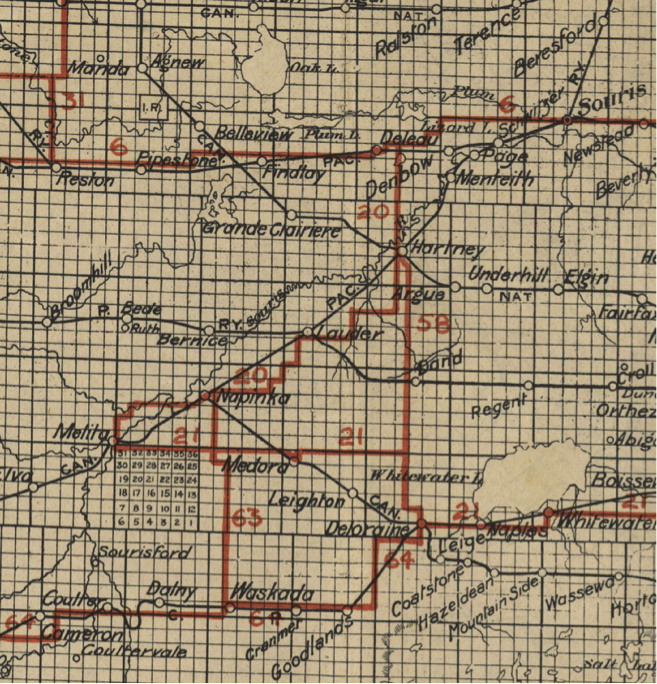 Automobile
Road Map of Manitoba (1924)
Emmett,
A.C. Automobile Road Map of Manitoba [map]. 1:760,320.
Winnipeg: Stovel Company Ltd., 1924.
Image
Courtesy of University of Manitoba Archives & Special
Collections
(Morris
Block fonds, MSS 207, A.05-43)
www.umanitoba.ca/libraries/units/archives/collections/com...
Automobile
Road Map of Manitoba (1924)
Emmett,
A.C. Automobile Road Map of Manitoba [map]. 1:760,320.
Winnipeg: Stovel Company Ltd., 1924.
Image
Courtesy of University of Manitoba Archives & Special
Collections
(Morris
Block fonds, MSS 207, A.05-43)
www.umanitoba.ca/libraries/units/archives/collections/com...
1925
A National Union of Methodist, Presbyterian and Congregational Churches
formalizes the many informal unions that had been taking place across
the prairies.
The Union Bank merged with the Royal under the name Royal Bank.
1926
Mr. Thomas J. Jamieson opened an office in Melita for the purpose of
furthering oil and gas exploration. P50
1928
Hartney United Church was built on the site of the former Methodist
Church – Reverend C.W. Gordon (Ralph Connor) was the guest
speaker at the opening.
1929
The MB Association of Poultry Producers had its origins in Hartney.
|
|


