
by Ruth Swan
Winnipeg
Manitoba History, Number 9, Spring 1985
|
Winnipegers have honoured their first mayor, Frank Cornish, by naming both a public library and a street after him. But few people know very much about him.
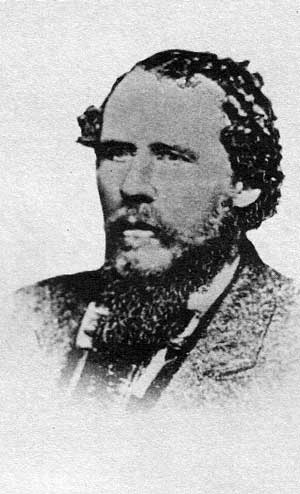
Francis Evans Cornish could be called a dandy, a political fixer and a rogue, but he epitomized the brawling and often bigoted spirit of frontier Winnipeg. An Orangeman from London, Ontario, Cornish emigrated to Manitoba in 1872 amid rumours of political scandal and corruption. Although he had an able reputation as a lawyer, Cornish had been accused of “bigamy, assault, drunkenness and boisterous public disputes,” [1] and of padding the ballot boxes when he was elected Mayor of London. [2] Cornish left his wife behind when he came out west, but not his bad habits, for he was soon involved in anti-French, anti-Catholic and anti-establishment shenanigans.
Shortly after he arrived, Cornish started agitating amongst those “Canadian” (Ontario) immigrants who were angry that they were not entitled to vote in the Dominion elections in 1872 because they had not been in Red River long enough to fulfill the residency requirements. On voting day, a group of Orangemen ransacked the St. Boniface polling station and burned the poll book. [3] They fought a group of unarmed Métis with wooden wheel spokes [4] and then returned to Winnipeg “crazed with excitement and liquor.” [5] Cornish leapt onto the back of a wagon on Main Street and harangued the mob, insulting the Governor, the head of the Hudson’s Bay Company and the Sheriff, and calling the Chief of Police a “toad-eating Communist.” [6] The mob could not be contained. Dr. John Christian Schultz, a leader of the Canadians and future Lieutenant-Governor of Manitoba, described the scene with great glee to a friend:
“In the twinkling of an eye, the Carbines were wrested from the police and they were rapped over the head with them. The police were then reinforced and proceeded to attack the crowd, but they were at once disarmed of their batons and they themselves thrust in the police station downstairs and locked up. In this scrimmage, Plainval (the Chief of Police) got badly beaten about the head and ran like a lamplighter. Word was sent then to the Governor and ... he ordered the troops down to quell the mob and preserve the peace til the result of the poll was declared.” [7]
The Sheriff posted a guard of militia around the Winnipeg polling station to prevent further vandalism. The rioters, being frustrated in their attempts to disrupt the election, proceeded to vandalize the offices of the three newspaper offices [8] thought to be sympathetic to the government. According to Schultz:
“The crowd had no possession. The police did not dare to interfere and the Manitoban office was broke into, the Press knocked down and the type scattered and the Métis office served the same way. No arrests have been made and nothing done today and I don’t think anything will be.” [10]
Lieutenant-Governor Archibald was having difficulty in establishing law and order. The Canadians thought they were fighting for their rights, but there is little doubt that the Orange Order and the violent rhetoric of men like Cornish heightened their anti-French paranoia. George Campbell participated in the rioting and described for friends in Ontario “the row we had at the election day.” After telling them about the fighting in St. Boniface and the rioting in Winnipeg, he described his cronies’ fear of reprisal from the Métis:
“So the next news came in to town that there was over 300 french half breeds armed acros [sic] the river and that they were going to make a raid on the town that evening and kill every canadian that they could see. So all the arms, Aminuition [sic] that the canadians could procure they stored in the Davis hotel and when the evening came every man was armed with revolvers and rifles straped [sic] round their shoulders but no half breed made there [sic] appearance ... [It] is not the half breeds alone we have to deal with but Hudson Bay men and all those men that is in power. They are on the half breeds side but wee [sic] have one smart man to stand us Mr. Cornish. I hope the day will soon come when we will have more of them.” [11]
The only newspaper office left unscathed in the attack was the Liberal, which indicates where Cornish’s political sympathies lay.
Cornish carried on his outspoken attacks against the French-speaking Metis. In 1873, he cooperated with Attorney-General Clarke to arrest Ambroise Lepine and Louis Riel for the murder of Thomas Scott. [12] This move caused considerable embarrassment for the government. While Riel was able to escape by leaving town, Lepine was not so lucky. He was arrested and imprisoned and nearly lynched by a violent mob. Frank Cornish later collected part of the reward offered by the Ontario Government for the arrest of the Métis leaders. Louis Riel and his friends were worried by the violent anti-Catholic and anti-French attacks by the Orangemen. [13]
In 1873, Cornish and many of the newcomers were agitating for the incorporation of the City of Winnipeg. [14] Much to their annoyance, the Provincial Government did not vote in a bill to their liking. Frank Cornish was one of the more outspoken critics of the government for its delay. The Speaker of the House was Dr. Bird and he became the target of abuse. Bird was blamed for delaying the passing of the bill. One evening, when out on a medical call which turned out to be a hoax, Bird’s carriage was waylaid, the doctor was dragged out and tarred. [15] No one was ever convicted of this offence, but many people in the incorporation movement were offended by such a violent threat to order and good government.
Once the incorporation of Winnipeg was achieved, Cornish carried on his political chicanery to win the first mayoralty election. On voting day, 5 January 1874, he received 383 votes while his opponent received 179. Since only 388 voters were registered, Alexander Begg observed wryly that there must have been a fair number of repeaters. [16] A loophole in the election law allowed a property owner one vote per property, and many people voted for their favourite more than once. Cornish was suspected of stuffing the ballot boxes, but nothing was proved against him.
Cornish’s flamboyant style won him many friends and supporters.
According to Begg:
“Mayor Cornish knew how to do things handsomely, for towards the close of his term in November ‘74, he gave a grand dinner to the aldermen and officers of the corporation in the Grand Central Hotel ... A mayor’s dinner ought to be given every year, but it isn’t.” [17]
Although he was popular with the Ontario immigrants who agreed with his Orange ideals, his wild behaviour and strong language made him unpopular with other politicians in both Manitoba and Ottawa. In 1872, after the election riots, Sir John A. Macdonald advised the Lieutenant-Governor to “put an end to this lawless spirit” and he advised him “by all means to get Cornish and Mulvey indicted.” [18] Cornish obviously did not hold the Prime Minister in high regard either for, when Macdonald’s government fell over the Pacific Scandal, Cornish and a friend became drunk in the street and tried to burn Sir John in effigy. His friend stood on an empty whiskey barrel to make a speech and spectators noted that there was more whiskey above the barrel than there ever was inside it. [19] Even Cornish’s political allies in the Liberal Party were of-fended by his behaviour. In 1876, a cabinet minister, Edward Blake, wrote:
“I received such an account of Cornish’s behaviour ... that I feel it impossible to retain him as my agent.” [20]
The former Mayor had probably upset many respectable citizens by leaving his wife in London and living with another woman in Winnipeg. After his death, his will did not mention his wife who survived him in London, but left most of his property to his “beloved Mary ... from Philadelphia.” [21]
In December, 1874, Cornish was elected M.L.A. for Poplar Point and joined the Opposition Party in the Provincial Legislature, a party which maintained an anti-French stand. He was an outspoken member and another colleague described a typical exchange in the Legislature:
“Davis (the Premier) and Cornish had crosfiring through language to each other it took up all day in haranguing and abusive language—kept up til half past seven from three.” [22]
Despite his one year term in office as Winnipeg’s first Mayor and a few terms as alderman, Cornish never achieved further political prominence. He may have aspired to lead the English-speaking MLAs, but lost out to John Norquay. [23] Although a talented lawyer and in some ways an able politician, his extremist views alienated many would-be supporters. He died in 1878 of stomach cancer. [24]
1. H. Bowsfield, “Francis Evans Cornish,” in Dictionary of Canadian Biography, Vol. X, (Toronto: 1972), p. 198.
2. E. Wells, Winnipeg: Where the New West Begins (Burlington: 1982), p. 104.
3. Donald Gunn Papers (PAM), Schultz to Gunn, 20 September 1872.
4. G. Campbell to friends in Ontario, Elections—Federal 1872, (PAM) 3 November 1872.
5. The Manitoban, Extra Edition, 21 September 1872.
7. Schultz to Gunn, 20 September 1872.
9. The Manitoban, 21 September 1872.
10. Schultz to Gunn, 20 September 1872.
11. Campbell to friends, 3 November 1872.
12. Alexander Morris Papers (PAM), Ketcheson Collection, Morris to Macdonald, 17 September 1873.
13. Louis Riel Papers (PAM), Cote to Riel, 25 January 1874; also Bourget to (Riel) 25 August 1874.
14. E. Paterson, “Angry Citizens Tarred the Doctor,” in Free Press, 18 November 1961, page 22.
16. A. Begg & W. Nursey, Ten Years in Winnipeg, (Winnipeg: 1879), page 94.
18. Morris Papers, Ketcheson Collection, Macdonald to Archibald, 7 October 1872.
19. John Christian Schultz Papers (PAM), Urquhart to Schultz, 29 March 1873.
20. Morris Papers, Ketcheson Collection, Blake to Morris, 6 December 1875.
21. F. E. Cornish (PAM), Last Will and Testament, 2 November 1878.
22. K. McKenzie (PAM), Journal and Account Book, 29 April 1875.
24. H. Bowsfield, “Francis Evans Cornish,” page 198.
Page revised: 18 December 2011